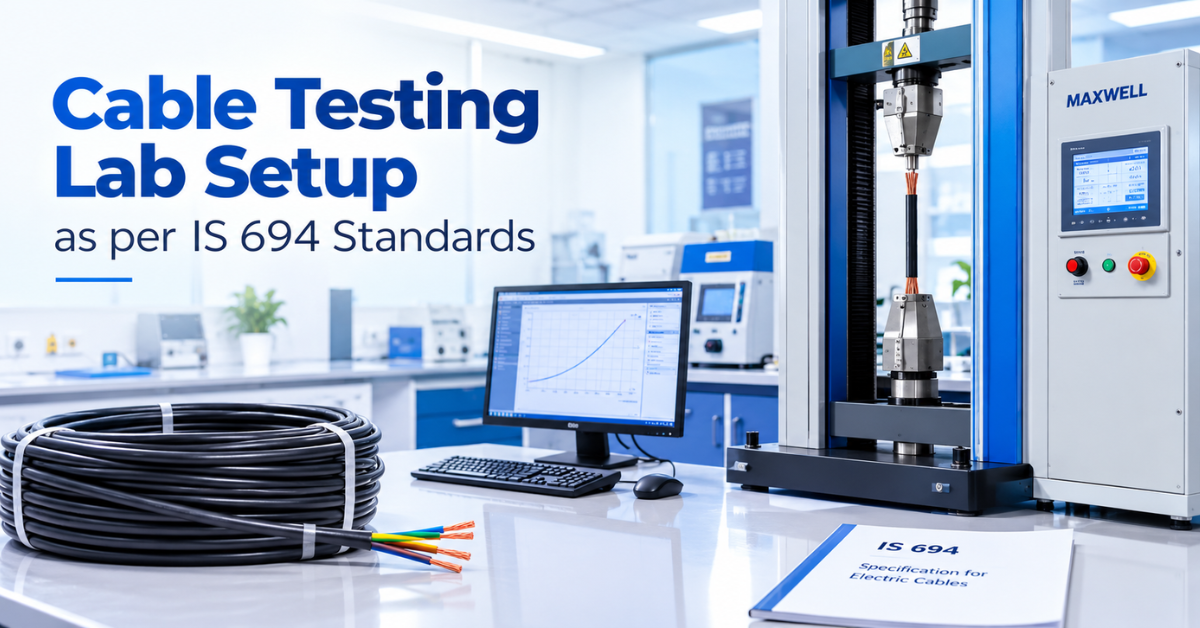
Setting up a cable testing lab isn’t just about buying a few instruments and putting them on a bench — it’s about assembling the right combination of equipment to verify every property a cable standard actually demands, from insulation resistance to dielectric strength to conductor resistance. For manufacturers and testing facilities working with PVC insulated cables in India, IS 694 is the standard that defines exactly what needs to be checked, and a compliant cable testing lab needs to be built around it deliberately.
This guide walks through what IS 694 covers, the core cable testing instruments a lab needs to meet it, and how to think about setting up a lab that’s genuinely equipped to test against this standard.
What Is IS 694?
IS 694 is the Indian Standard covering PVC insulated cables and cords for working voltages up to and including 1100V, widely used across household wiring, industrial installations, and general electrical applications. It specifies requirements for conductor construction, insulation properties, dimensional tolerances, and a range of electrical and mechanical tests that a cable must pass before it can be considered compliant.
Because the standard covers so many different properties — electrical, mechanical, and dimensional — a lab set up to test against IS 694 needs more than one or two instruments. It needs a coordinated set of cable testing instruments, each addressing a specific requirement in the standard.
Core Requirements Covered Under IS 694
Before setting up a lab, it helps to understand what IS 694 actually requires testing for. Broadly, this includes:
- Conductor resistance — confirming the conductor meets its specified resistance value
- Insulation resistance — checking that the insulation adequately resists current leakage
- Dielectric strength / high voltage withstand — confirming the cable can withstand voltage well above its rated level without breakdown
- Dimensional checks — verifying conductor diameter, insulation thickness, and overall cable dimensions
- Mechanical properties — including tensile strength and elongation of the insulation
- Ageing resistance — assessing how insulation properties hold up after accelerated ageing
- Spark/pinhole detection — checking for defects in the insulation along the length of the cable
Each of these requirements maps to a specific instrument or test setup, which is where lab planning actually begins.
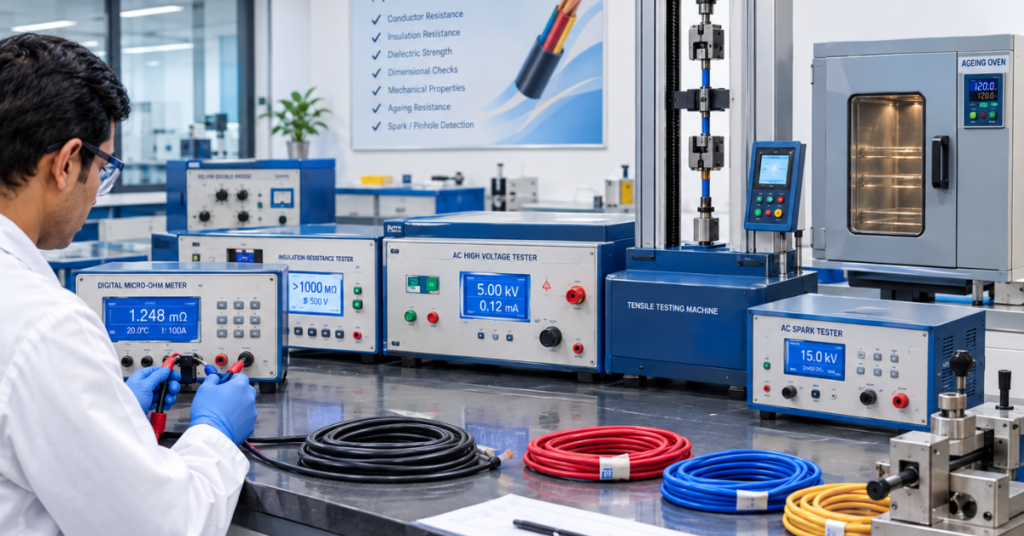
Essential Cable Testing Instruments for an IS 694-Compliant Lab
1. Digital Micro-Ohm Meter
Conductor resistance is one of the most fundamental checks in cable testing, and a digital micro-ohm meter is built specifically for this. Using a 4-terminal Kelvin measurement method, it measures conductor resistance with high accuracy, and models with automatic temperature compensation calculate resistance at a standard 20°C reference, removing the need for manual correction. This instrument is central to verifying conductor resistance requirements under IS 694 and related standards like IS 10810 Part 5.
2. AC High Voltage Breakdown Tester
Dielectric strength testing — confirming a cable’s insulation can withstand voltage well above its rated level — is carried out using an AC high voltage tester. Designed for BIS 694 compliant testing, these instruments typically apply voltage in the 5–10 kV range while monitoring leakage current on digital meters, helping labs verify insulation integrity as part of routine and batch testing.
3. DC High Voltage Breakdown Tester
For applications and standards where DC testing is more appropriate, a DC high voltage breakdown tester serves the same core purpose — pushing voltage up in a controlled way to confirm insulation withstand levels, with digital voltage display and trip settings for safe, repeatable operation.
4. Million Megohm Meter / Insulation Resistance Tester
Insulation resistance testing checks how effectively a cable’s insulation resists current leakage under a defined test voltage. A million megohm meter measures this resistance at high sensitivity, giving labs a reliable, non-destructive way to routinely confirm insulation quality.
5. AC Spark Tester
Spark testing is used to detect pinholes and small defects in cable insulation, typically as an inline or production-line check. An AC spark tester applies a high-voltage output — commonly adjustable up to 15kV — across the insulation surface, flagging any weak points before the cable moves further down the production line.
6. Kelvin Double Bridge
For labs needing an alternative or complementary method of precise low-resistance measurement, a Kelvin Double Bridge is a classic instrument used specifically in cable testing laboratories, particularly for conductor resistance verification where a bridge-based measurement is preferred.
7. Digital Conductivity Meter
Beyond resistance, cable manufacturers often need to verify conductor material quality itself. A digital conductivity meter, using the same 4-terminal Kelvin method, calculates conductivity relative to a reference standard, helping confirm that copper or aluminium conductors meet expected material quality — an important complement to a straightforward resistance check.
8. Tensile Testing Machine
Mechanical properties matter as much as electrical ones. A tensile testing machine evaluates the tensile strength and elongation of cable insulation and sheathing materials, confirming they meet the mechanical requirements specified under IS 694.
9. Ageing Oven
Insulation materials need to retain their properties over time and under thermal stress. An ageing oven subjects insulation samples to controlled, elevated temperatures over a defined period, after which properties like tensile strength and elongation are re-tested to confirm the material hasn’t degraded beyond acceptable limits.
10. Cable Slicing Machine and Clamping Systems
For accurately preparing cable samples — particularly larger cables with significant conductor cross-sections — a cable slicing machine and appropriate clamping systems help ensure consistent sample preparation, which directly affects the reliability of subsequent tests.
How These Instruments Work Together in a Lab Setup
A well-planned IS 694 cable testing lab isn’t just a collection of individual instruments — it’s a workflow. A typical sequence might look like this:
- Sample preparation — cutting and preparing cable samples using slicing machines and clamping systems
- Dimensional checks — verifying conductor diameter and insulation thickness
- Conductor resistance testing — using a digital micro-ohm meter or Kelvin Double Bridge
- Insulation resistance testing — using a million megohm meter for a non-destructive resistance check
- Dielectric strength testing — using an AC or DC high voltage breakdown tester to confirm withstand voltage
- Spark testing — checking for pinholes and insulation defects, often during production
- Mechanical testing — evaluating tensile strength and elongation, both before and after ageing
- Ageing testing — assessing long-term material stability using an ageing oven
Running through this sequence consistently is what gives a lab the ability to certify, with confidence, that a cable genuinely meets IS 694 requirements.
Conclusion
Setting up a cable testing lab as per IS 694 comes down to assembling the right combination of instruments — covering conductor resistance, insulation resistance, dielectric strength, mechanical properties, and ageing performance — and running them as a coordinated testing workflow rather than isolated checks. A properly equipped lab doesn’t just tick compliance boxes; it gives manufacturers and testing facilities genuine confidence that the cables leaving their facility are safe, reliable, and built to last under real-world conditions.
Frequently Asked Questions
1. What does IS 694 cover?
IS 694 is the Indian Standard for house wire/PVC insulated cables and cords up to 1100V, specifying requirements for conductor construction, insulation properties, dimensional tolerances, and various electrical and mechanical tests.
2. What instruments are essential for an IS 694 cable testing lab?
Core instruments include a digital micro-ohm meter, AC and DC high voltage breakdown testers, a million megohm meter, an AC spark tester, a tensile testing machine, and an aging oven, among others.
3. Why is both insulation resistance and dielectric strength testing needed?
Insulation resistance testing is a non-destructive check of insulation quality at low voltage, while dielectric strength testing deliberately raises voltage to confirm the insulation’s actual safety margin before breakdown — both give different, complementary information.
4. What is spark testing used for in cable manufacturing?
Spark testing uses a high-voltage AC spark tester to detect pinholes and small insulation defects along a cable’s length, typically as part of production-line quality control.
5. Why is ageing testing included in cable compliance testing?
Ageing testing checks whether insulation properties like tensile strength and elongation remain within acceptable limits after exposure to elevated temperatures over time, confirming the material’s long-term stability.
6. Is it mandatory to use a Kelvin double bridge in the lab instead of a micro-ohm meter?
As per the requirement of IS 694 Kelvin Double Bridge is a mandatory requirement because during inspection inspectors have found out a lot of faulty or manipulated micro-ohm meters while Kelvin Double Bridge always shows the correct resistance values due to null deflection point.