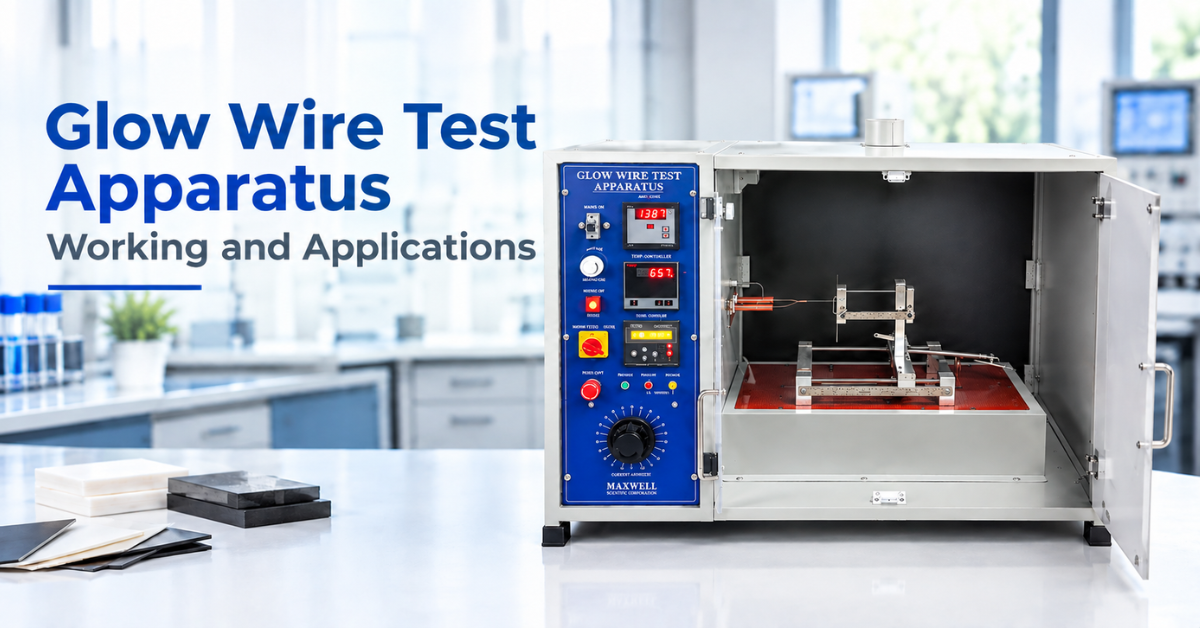
An electrical fault rarely announces itself with a bang. More often, it starts as heat — a stressed connection, an overloaded track, a component running hotter than it should — sitting right next to a plastic housing that was never meant to handle that kind of temperature. Whether that plastic catches fire or simply chars and self-extinguishes is the exact question a glow wire test apparatus is designed to answer.
This instrument has become a standard fixture in electrical safety labs, and for good reason — it’s one of the more direct ways to check whether a material poses a genuine fire risk under realistic fault conditions. This article walks through exactly how the test works, step by step, and where it gets applied across different industries.
What Is a Glow Wire Test Apparatus?
A glow wire test apparatus is a laboratory instrument that evaluates how plastics and other insulating materials respond when exposed to a controlled source of localized heat — specifically, an electrically heated wire loop. It’s designed to simulate a very specific, realistic fault scenario: a glowing or overheating element, such as an overloaded resistor or a poor connection, coming into brief contact with the plastic parts surrounding it inside an electrical product.
Rather than testing with an open flame, which introduces variables that are hard to control and repeat, the glow wire method relies on a heated wire held at a defined temperature for a defined time. This makes the test both safer to run and far more repeatable across different samples and labs.
How Does the Glow Wire Test Actually Work?
Step 1: Heating the Wire to Test Temperature
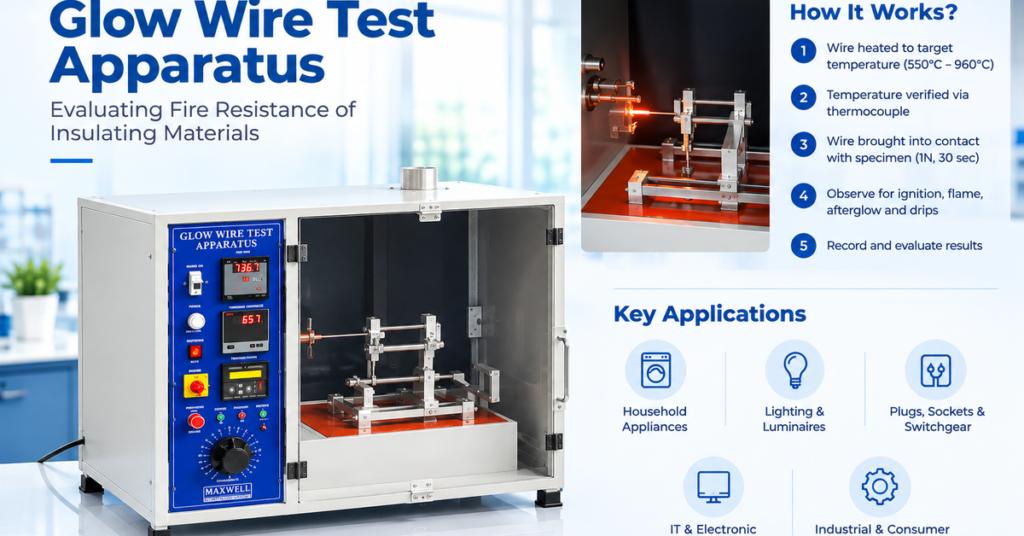
The apparatus heats a loop of nickel-chromium wire electrically until it reaches a specific target temperature — commonly somewhere between 550°C and 960°C, chosen based on the product category and the relevant standard being applied. Lower temperatures are typically used for components not directly near a source of fault current, while higher temperatures apply to parts that could realistically be exposed to more severe overheating.
Step 2: Verifying the Temperature Is Accurate
A thermocouple built into the wire assembly, positioned near its tip, continuously tracks the wire’s actual temperature. This step matters more than it might seem — the test is only valid if the wire is genuinely at the intended temperature when contact happens, so this measurement has to be accurate and stable before the test proceeds.
Step 3: Bringing the Wire Into Contact With the Specimen
Once the correct temperature is confirmed, the heated wire tip is pressed into the test specimen using a defined, consistent force — around 1 Newton — and held there for a set duration, typically 30 seconds. The specimen sits securely in a holder throughout, so the contact remains stable and consistent regardless of who’s running the test.
Step 4: Withdrawing the Wire and Observing
After the contact period ends, the wire is pulled back, and the specimen is observed closely. The key things being watched for:
- Whether the specimen ignites at all
- How long any flame or glowing continues once the wire is removed
- Whether any flaming material drips down and could set fire to something below
- Whether the specimen has retained enough structural integrity to still function safely
Step 5: Recording the Outcome
All of this happens inside an enclosed safety chamber, both to protect the operator and to allow clear, safe observation of any flame or glow. Timers log exactly how long any afterglow or flame persisted, and this data gets compared against the pass/fail criteria set by whichever standard applies.
The Standards Behind the Test
Glow wire testing is anchored by a well-established set of international and Indian standards.
The IEC 60695-2 series is the primary international reference. IEC 60695-2-10 defines the general apparatus and test method, while 60695-2-11, -2-12, and -2-13 cover more specific test types — the Glow Wire Flammability Test on finished products, the Glow Wire Flammability Index (GWFI), and the Glow Wire Ignition Temperature (GWIT).
In India, IS 1293 governs glow wire requirements for plastic materials used in plugs and sockets, and the broader IS 11000 series aligns with the IEC 60695 framework. Products subject to India’s Compulsory Registration Scheme (CRS) frequently need to show glow wire compliance before they can be registered for sale.
These standards also get referenced inside larger product safety frameworks — IEC 60335 for household appliances, IEC 60598 for luminaires, and IEC 60884-1 for plugs and sockets, among others.
Applications of Glow Wire Testing
Glow wire testing applies to any product where insulating plastic sits close enough to live electrical parts that an internal fault could genuinely ignite it. In practice, that covers a lot of ground:
Household Appliances
Kettles, toasters, heaters, and similar appliances all contain plastic housings and internal components positioned near heating elements or electrical connections, making glow wire testing a routine requirement.
Lighting and Luminaires
LED fixtures and other lighting products get tested to confirm their plastic housings and internal components won’t ignite if a driver or connection overheats.
Plugs, Sockets, and Switchgear
Since these products handle current directly and often sit inside walls or enclosed spaces, verifying their plastic components resist ignition under fault conditions is a core safety requirement.
IT and Electronic Equipment
Power supplies, adaptors, and general electronics all include internal plastic parts that need to demonstrate adequate fire resistance near current-carrying components.
Industrial and Consumer Electronics
Control panels, consumer devices, and similar products go through the same testing to confirm their materials meet the applicable safety threshold before certification.
It’s worth being clear that this test is specific to plastics and insulating materials — it isn’t relevant to metal parts, since it’s measuring flammability response rather than any property metals would exhibit.
Why the Glow Wire Test Is Structured This Way
The design of the test — a heated wire rather than an open flame, a fixed contact force, a defined duration — isn’t arbitrary. It’s built to replicate a real, specific failure mode as closely and repeatably as possible, so that results from different labs and different batches of the same material can actually be compared against each other. An open flame test would introduce far more variability, making it much harder to get consistent, comparable results across repeated testing.
What to Look for in a Glow Wire Test Apparatus
If you’re selecting equipment for this kind of testing, a few things are worth prioritizing:
- Accurate temperature control, since the entire test hinges on the wire being at precisely the right temperature during contact
- Reliable thermocouple measurement built into the wire assembly for continuous, real-time monitoring
- Consistent force and timing mechanisms, so contact pressure and duration stay the same test after test
- A properly enclosed safety chamber for safe observation and operator protection
- Compliance with the specific standard your products need to meet — commonly IEC 60695-2-10 or IS 1293
Glow Wire Test Apparatus at Maxwell
Maxwellindia manufactures a Glow Wire Test Apparatus built to IS 1293 and IEC 60695-2-10, designed to evaluate the fire resistance and ignition behavior of insulating materials and electrical components. It’s suited for testing plugs, sockets, and similar electrical accessories, and Maxwell also supplies spares such as replacement thermocouples for the glow wire assembly — a practical, standards-compliant option for laboratories, manufacturers, and certification centres running regular glow wire testing.
Conclusion
The glow wire test apparatus works by recreating a very specific, realistic hazard — a localized overheating fault touching nearby plastic — in a controlled, repeatable way. Its applications span nearly every category of electrical product where insulating material sits close to live parts, from household appliances to plugs and sockets to lighting fixtures. Understanding how the test operates, and why it’s built the way it is, makes it a lot easier to interpret results correctly and choose equipment that genuinely supports reliable, standards-compliant safety testing.
Frequently Asked Questions
1. How does a glow wire test apparatus simulate a real fault condition?
It uses an electrically heated wire held at a defined temperature to recreate the effect of an overheating component or connection coming into brief contact with nearby plastic parts.
2. What temperature is the glow wire typically heated to?
Temperatures generally range from around 550°C to 960°C, depending on the product category and which standard is being applied.
3. What materials is the glow wire test used for?
It applies specifically to plastics and other insulating materials, not metal components, since it’s evaluating flammability behavior.
4. Which industries commonly require glow wire testing?
Household appliances, lighting and luminaires, plugs and sockets, switchgear, IT equipment, and general consumer electronics all commonly require it.
5. What determines a pass or fail result in glow wire testing?
A material generally passes if it doesn’t ignite at the test temperature, any flame or afterglow extinguishes within the allowed time, and no flaming drips ignite material placed below the specimen.