Profile Projector – Principle, Working, Applications & Buying Guide
In this post, we explain how a Profile Projector (also known as an Optical Comparator) helps industries achieve highly accurate dimensional measurement, inspection, and quality control of components. We will cover what a profile projector is, how it works, its major applications, key advantages, standards it supports, and how to choose the right one for your laboratory or production unit.
In today’s high-precision world, where even a micron-level error can cause rejection of an entire batch, optical measurement is no longer a luxury — it is a necessity.
A Profile Projector provides a non-contact, highly accurate, and enlarged image of a component, making it easy to check profiles, radii, angles, lengths, and geometries against drawings or master samples.
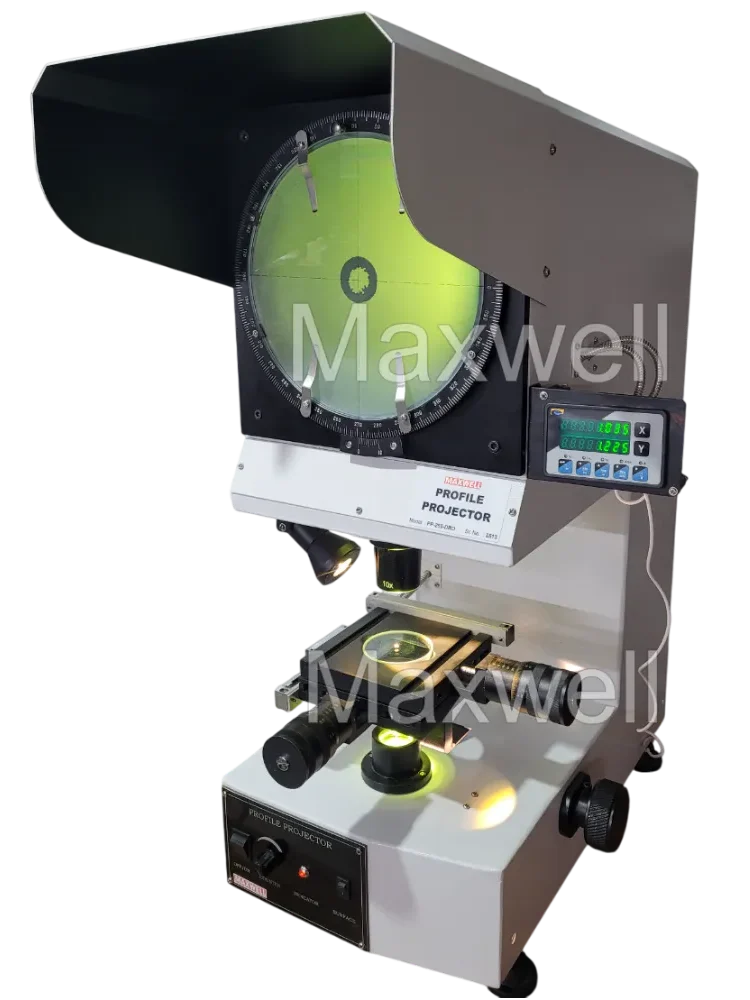
What is a Profile Projector?
A Profile Projector is an optical measuring instrument used to project a magnified silhouette (shadow image) of a component onto a vertical or horizontal screen. This projected image is then compared with:
- Standard templates
- CAD drawings
- Overlay charts
- Digital readouts (DRO)
It is commonly used to measure:
✅ Length & width
✅ Angle
✅ Radius / Fillet
✅ Thread profile
✅ Chamfer
✅ Hole position
✅ Complex contours
Because it is a non-contact measuring system, there is no risk of damaging delicate components.
Other Names for Profile Projector
A profile projector is also known as:
- Optical Profile Projector
- Optical Comparator
- Contour Projector
- Shadowgraph Projector
All these refer to the same type of optical inspection instrument.

How Does a Profile Projector Work? (Principle of Operation)
The working principle is simple but powerful:
- A bright halogen/LED light source illuminates the component placed on the glass stage
- The light creates a shadow (silhouette) of the object
- A lens system magnifies this image
- The image is projected onto a ground glass screen
- The operator compares the enlarged image with the drawing / overlay or measures it using a Digital Readout (DRO)
Working Flow:
Light source → Sample → Objective lens → Mirror → Projection screen → Measurement via DRO
Magnification options generally include:
- 10X
- 20X
- 50X
- 100X
This means a 1 mm feature appears as 10 mm, 20 mm, 50 mm or 100 mm on screen.
Types of Profile Projectors
There are mainly two types of profile projectors:
Vertical Profile Projector
- Image projected vertically on an upright screen
- Most commonly used
- Easy for larger and heavier components
Horizontal Profile Projector
- Projection is horizontal
- Best for long, cylindrical, and shaft-type components
Why Do You Need a Profile Projector?
In industries where precision is critical, normal tools like Vernier calipers, travelling microscope and micrometers are not enough.
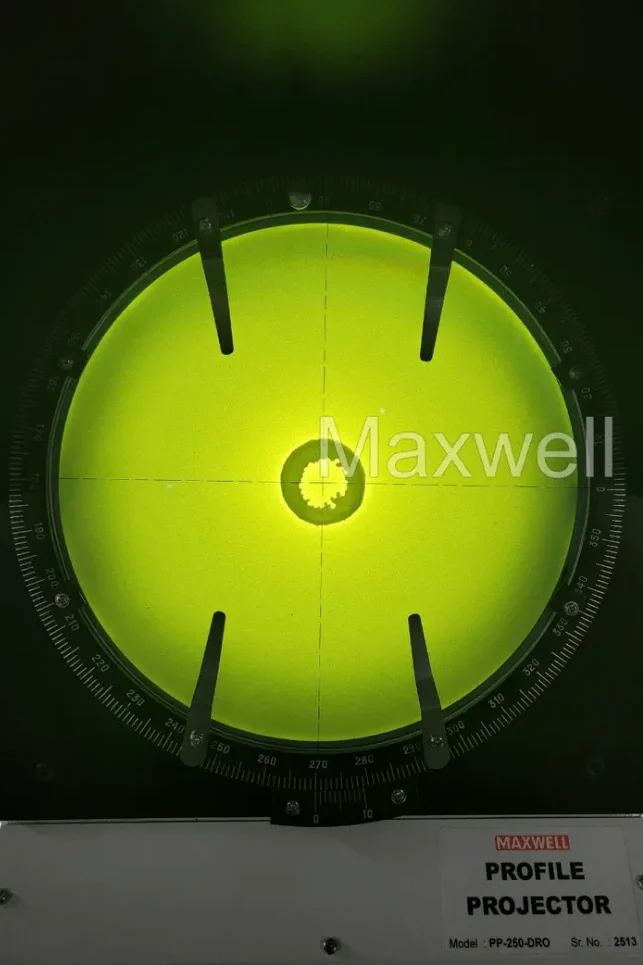
A profile projector helps you:
✅ Inspect complex geometries
✅ Measure angles and radii precisely
✅ Reduce human error
✅ Achieve fast inspection
✅ Improve product quality
✅ Reduce rejection rate
✅ Maintain consistency in production
✅ Meet international standards
This makes it a must-have in:
- Tool Rooms
- Quality Control Departments
- R&D Labs
- Production Units
- Government & Defence Labs
Applications of Profile Projector
A Profile Projector is widely used in:
Mechanical & Manufacturing Industry
- Gears
- Shafts
- Dies
- Molds
- Turned components
- Cable cross-section analysis
- Machined parts
Electronics Industry
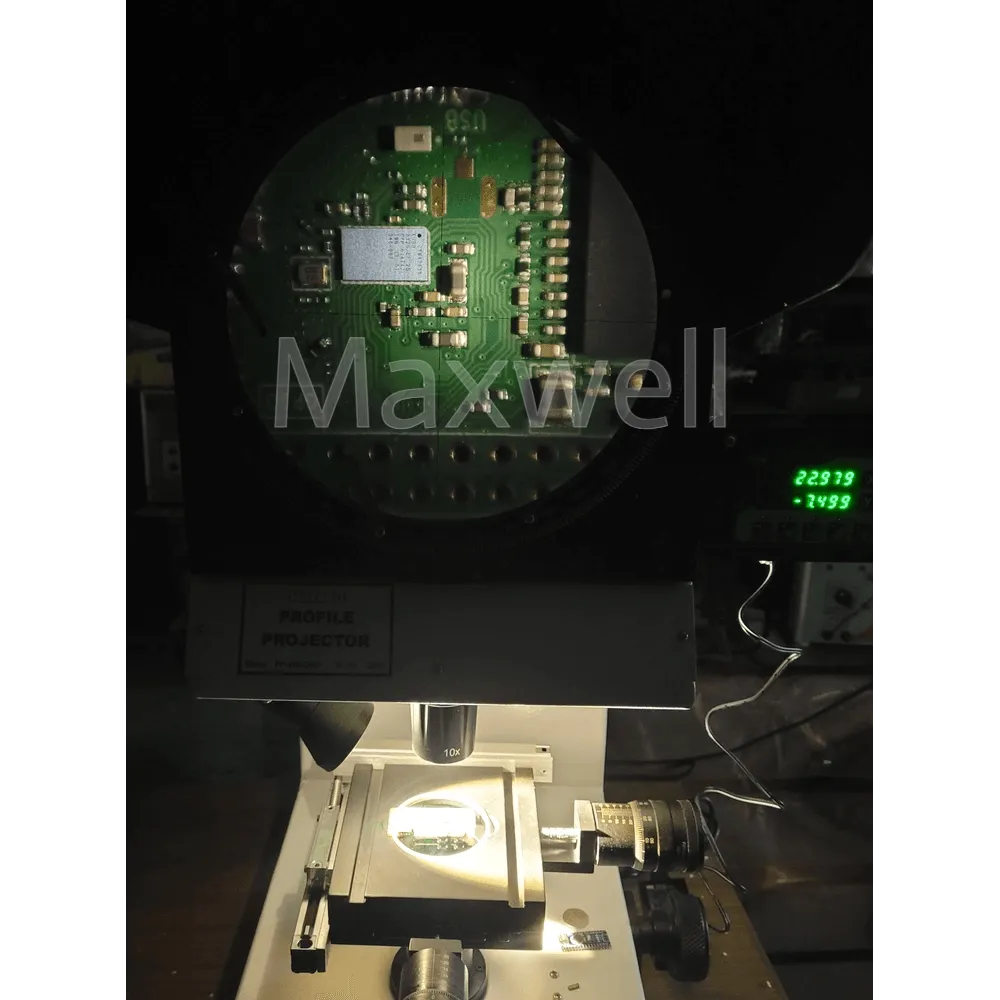
- PCB inspection
- IC leads & pins
- Micro connectors
- SMD components
Automotive Industry
- Engine parts
- Valve profiles
- Piston rings
- Transmission components
Aerospace & Defence
- High-precision components
- Prototype inspection
- Reverse engineering
- Critical safety parts
Medical Device Manufacturing
- Surgical instruments
- Needles & implants
- Micro-tools
Anywhere precision matters, a profile projector is required.
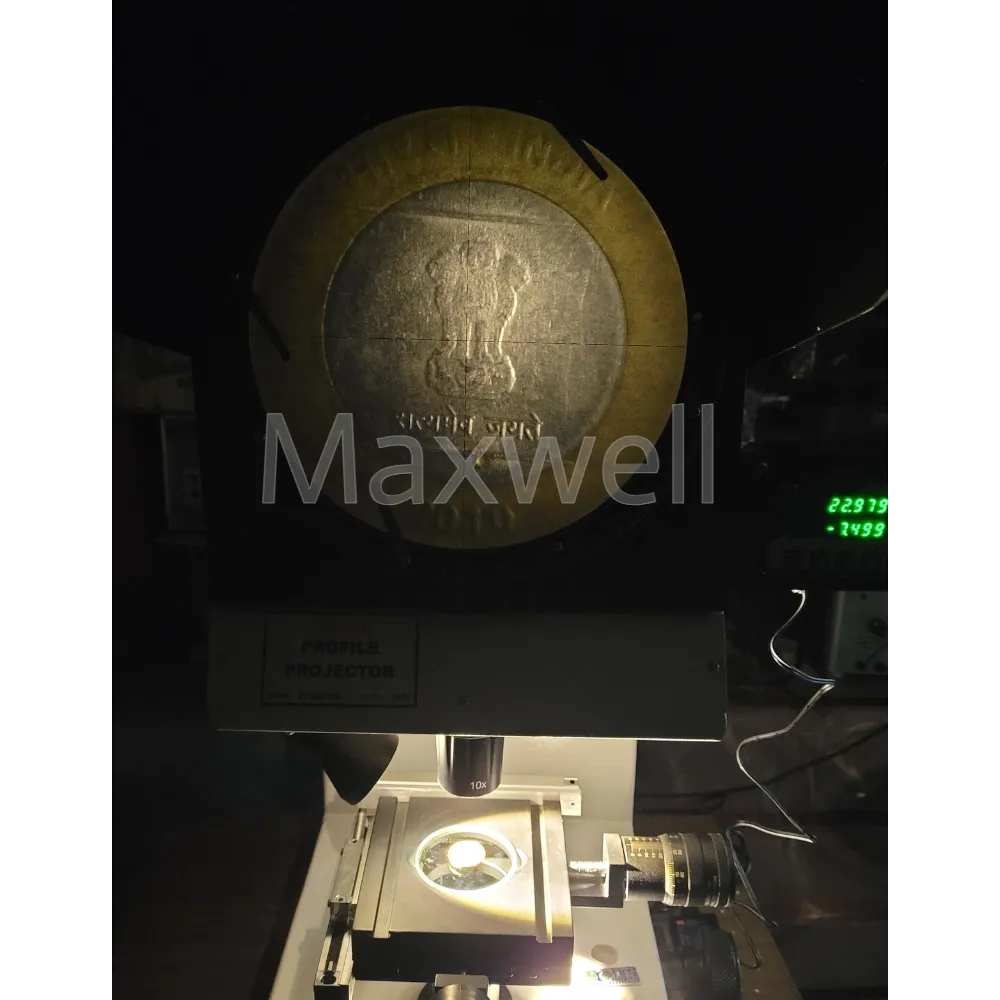
Key Components of a Profile Projector
A standard Profile Projector includes:
- High-quality optical lens
- LED / halogen light source
- Glass working stage
- Digital readout system (DRO)
- Projection screen (usually 300mm–600mm diameter)
- X & Y micrometer movement
- Rotary table (optional)
- Clamps & V-blocks
What Can Be Measured Using a Profile Projector?
Using a Profile Projector, you can measure:
- Linear dimensions
- Angles (internal & external)
- Radius of curves
- Pitch of threads
- Chamfer length
- Hole locations
- Concentricity
- Profile deviation
- Edge roughness (indirect checking)
This makes it much more versatile than traditional mechanical gauges.
Standards Related to Profile Projector
Though profile projectors are general-purpose instruments, they help ensure compliance with:
- ISO 10360, ISO 1101
- DIN engineering tolerances
- ASTM mechanical inspection guidelines
- IS 10810 (Part 6) (Indian Standard)
- Japanese standard – JIS B 7184
- and many more
They are heavily used in ISO 9001, IATF 16949, and AS 9100 certified companies.
Manual vs Digital Profile Projector
| Feature | Manual | Digital |
|---|---|---|
| Reading | Manual scale | Digital DRO |
| Accuracy | Good | Higher |
| Speed | Medium | Fast |
| Report | Manual | Computer-generated |
| Cost | Lower | Higher |
| Recommended use | Basic QC | Advanced QC & R&D |
Many modern units also offer USB connectivity & software-based image processing.
How to Choose the Right Profile Projector? (Buying Guide)
Before purchasing, consider:
- Screen size (8 inch / 10 inch / 12 inch)
- Magnification requirements (10x, 20x, 50x)
- Component size & weight
- Manual or digital model
- Need for software
- Availability of service & calibration
- Make in India / Imported : Prefer Indian high quality profile projectors as after sales support is time consuming and costly in Imported ones.
For heavy industrial use, choose models with:
✅ Rigid body
✅ Stable optics
✅ High contrast screen
✅ Long life LED source

Profile Projector Manufacturers:
Maxwell (India)
A well known name in testing instruments manufacturer & supplier in India. With proven track record in cable testing instruments as per IS standard, Maxwell offers Profile Projector with screen size up to 12 inches and variable optical zoom (10x / 20x / 50x) as per the requirement.
Availability of affordable options in Profile Projector and starting price of Rs 50,000 makes it a perfect fit for all industry types.
Mitutoyo (Japan)
Very established name in metrology. They make a wide range of precision measuring instruments, including optical comparators / profile projectors, CMMs (coordinate measuring machines), surface measuring and dimensional-gauging tools.
Mitutoyo is widely used globally for high-precision measurement and quality control.
Keyence (Japan)
KEYENCE is a global automation / measurement / inspection-equipment company. Their product portfolio includes measuring instruments, machine-vision systems, sensors, digital microscopes and inspection / metrology tools.
They may not be a “classic” profile projector-only vendor, but as a metrology/inspection supplier they cover many advanced measuring & vision systems.
L. S. Starrett (USA)
Long-established US company producing tools, measuring instruments, gauges, cutting tools — and also metrology equipment including optical comparators / profile projectors and vision systems
Qualitest (USA)
From USA, Qualitest provides high end solutions for Profile Projectors. Offering Vertical and Horizontal Profile projector with DRO and digital options available to chose from. In India, the after sales service might be an issue as it is time consuming.
HAIDA International Equipment (China)
Produces optical comparators / profile projectors and metrology equipment; often more budget-oriented or cost-effective, suitable for buyers needing functional comparators rather than premium global-OEM level.
The only drawback is after sales support and availability of spare parts in India.
Dynascan (India)
Bengaluru based Indian manufacturer of video measuring systems and inspection systems.
How to use a Profile Projector?
Watch the video to know how to use Maxwell profile projector for measuring angle, radius, diameter, depth, length & width.
FAQs
Can profile projectors measure 3D shapes?
No. Profile projectors are limited to 2D measurements only. They project the silhouette of an object onto a screen, allowing only two-dimensional analysis.
Are profile projectors still relevant in 2025?
Yes. They continue to provide excellent value for cost-effective, high-precision 2D inspection, especially in production and quality control environments.
How accurate are modern profile projectors?
Contouring accuracy can be as tight as 0.08%, making them suitable for tight-tolerance parts and critical dimensional inspection.
What is a profile projector used for?
A profile projector is used to measure and inspect the dimensions, contours, angles, radii, and profiles of small mechanical components by projecting an enlarged silhouette onto a screen.
What kinds of parts are best measured with a profile projector?
Flat parts, edge profiles, small intricate components, rubber and plastic items, and flexible materials are ideal for profile projector measurement.
What is the difference between a profile projector and a microscope?
A profile projector shows an enlarged silhouette (shadow image) on a screen for measurement, while a microscope provides a direct optical view of the object’s surface for inspection and analysis.
Is contact required when measuring with a profile projector?
No. Profile projectors are non-contact measuring instruments, making them ideal for measuring soft, delicate, and flexible materials without deformation.
What types of illumination are used in profile projectors?
Profile projectors use two main types of illumination:
- Reflected (top) light for surface inspection
- Transmitted (bottom) light for silhouette measurement
Can a profile projector measure angles and radii?
Yes. Most profile projectors are equipped with protractors and digital angle measurement features to accurately measure angles, arcs, and radii.
What are the main components of a profile projector?
Key components include the projection screen, illumination system, worktable, optical lens, measuring scale (DRO), and focus mechanism.
What is the difference between horizontal and vertical profile projectors?
Vertical profile projectors project the image upward to a horizontal screen (better for heavy parts), while horizontal projectors display the image on a vertical screen (better for quick observation).
Are digital profile projectors available?
Yes. Modern profile projectors often come equipped with digital readout (DRO), image processing software, and USB/PC connectivity for data storage and reporting.
What is the standard screen size of a profile projector?
Common screen sizes include 12”, 14”, 16”, 20”, and 24” diameter, depending on the model and measurement requirements.
Can profile projectors be used for batch inspection?
Yes. They are commonly used in production lines for quick first-article inspection and batch quality checks.
What maintenance is required for profile projectors?
Basic maintenance includes lens cleaning, bulb replacement, calibration checks, and periodic lubrication of the moving parts.
Are profile projectors compliant with international standards?
Yes. They are used in compliance with standards such as ISO, DIN, ASTM, and IS for dimensional inspection and quality assurance.
What is the typical magnification range of a profile projector?
Common magnifications include 5X, 10X, 20X, 50X and 100X, depending on the model and application.
Can beginners use profile projectors?
Yes. Profile projectors are easy to operate, with a simple working principle and minimal training requirements.
Final Conclusion
In modern manufacturing, accuracy defines quality. A Profile Projector is one of the most reliable, versatile, and essential tools for dimensional inspection. It reduces dependency on manual judgment and ensures every product meets its intended design and tolerance.
Whether you are producing a micromechanical part, a PCB component, or a heavy machine tool — a profile projector becomes your visual quality guardian.
If precision matters in your business, a Profile Projector is not just an instrument — it is an investment in quality, reputation, and growth.