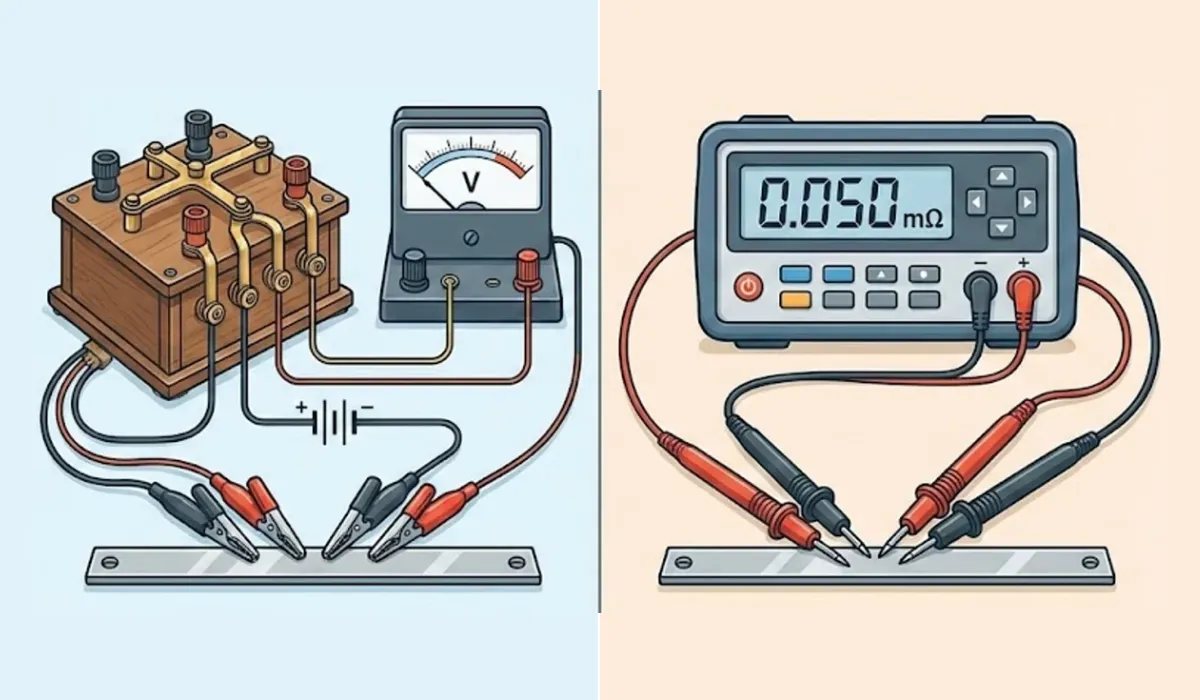
Kelvin Double Bridge vs Micro-Ohm Meter: A Complete Comparison for Low Resistance Measurement
Accurate measurement of very low resistance values is critical in electrical testing, quality control, and research laboratories. Whether it is testing conductor resistance, contact resistance, joints, busbars, or bonding resistance, even a small error can lead to incorrect conclusions, overheating, or product failure.
Traditionally, the Kelvin Double Bridge has been the reference instrument for micro-ohm measurements. However, with advancements in electronics, the Micro-Ohm Meter has emerged as a faster, more user-friendly, and portable alternative.
This blog provides a detailed comparison between Kelvin Double Bridge and Micro-Ohm Meter, helping engineers, laboratories, and manufacturers choose the right instrument for their application.
Understanding Low Resistance Measurement
Low resistance measurement typically refers to resistance values in the range of:
- Micro-ohms (µΩ)
- Milli-ohms (mΩ)
- Low ohms (Ω)
At these levels, lead resistance, contact resistance, and thermal EMFs can significantly affect the accuracy of measurements. This is why four-wire (Kelvin) measurement technique is used in both Kelvin Double Bridge and Micro-Ohm Meters.
What is a Kelvin Double Bridge?
The Kelvin Double Bridge is a precision DC bridge circuit used to measure very low resistances, typically below 1 ohm, with high accuracy.
It is an improved version of the Wheatstone bridge, specifically designed to eliminate errors caused by lead and contact resistances.
Working Principle of Kelvin Double Bridge
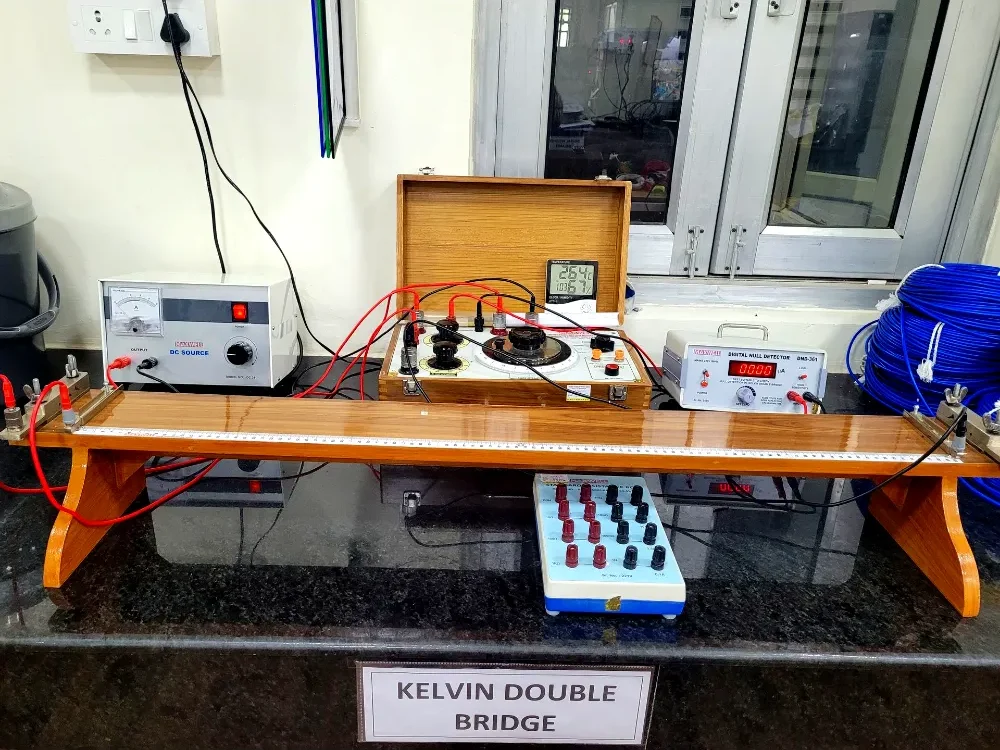
The Kelvin Double Bridge uses:
- A known standard resistor
- Ratio arms
- A sensitive galvanometer
- A stable DC source
By balancing the bridge, the unknown resistance is determined by comparing it against a standard resistance. The double bridge arrangement compensates for lead resistance, making it suitable for micro-ohm measurements.
Key Characteristics of Kelvin Double Bridge
- Manual balancing required
- Requires skilled operator
- High accuracy under controlled conditions
- Sensitive to temperature and vibration
- Time-consuming measurement process
What is a Micro-Ohm Meter?
A Micro-Ohm Meter is an electronic instrument designed to measure low resistance values quickly and accurately using a constant current injection method.
The instrument passes a known DC current through the test sample and measures the voltage drop using high-resolution ADCs. Resistance is calculated using Ohm’s law.
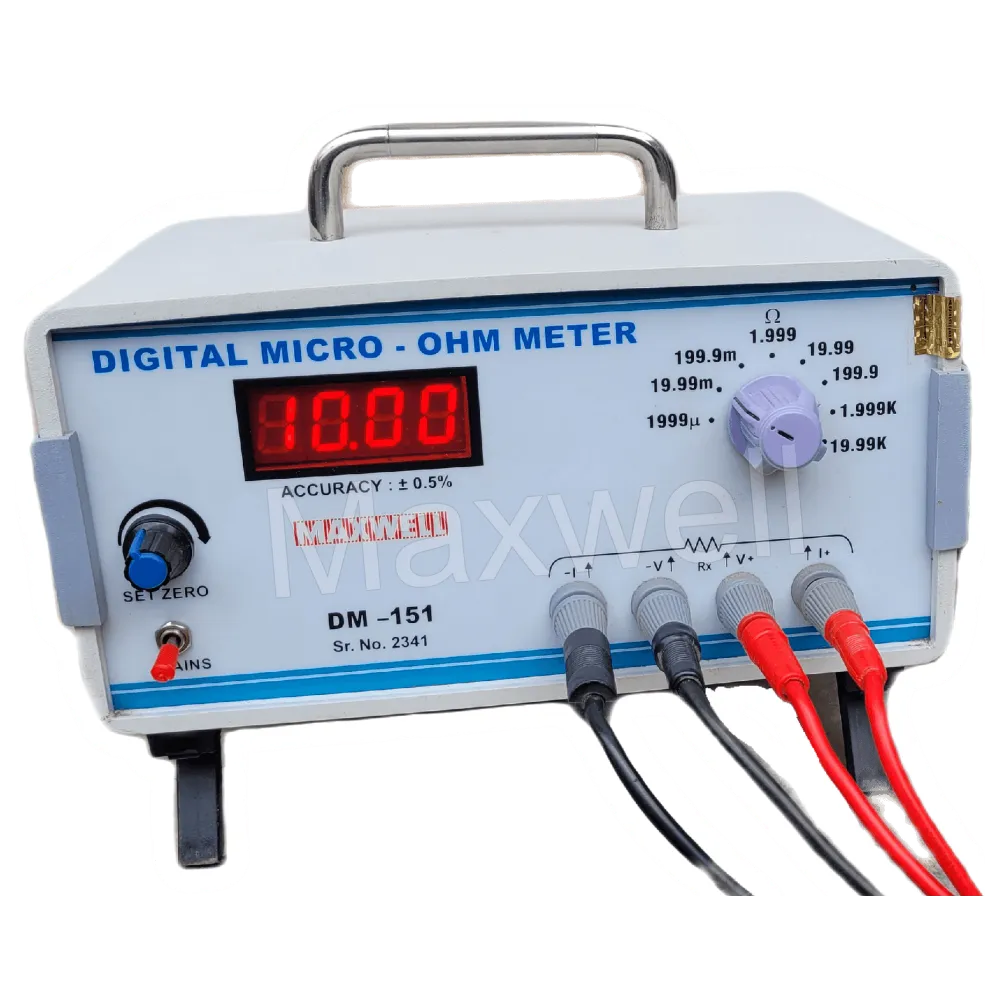
Working Principle of Micro-Ohm Meter
- A constant current source injects current through the test object.
- A four-wire Kelvin connection senses the voltage drop.
- A microcontroller processes the signal.
- The resistance value is displayed digitally.
Key Characteristics of Micro-Ohm Meter
- Automatic measurement
- Digital display
- Fast readings
- Portable and field-friendly
- Minimal operator dependency
Kelvin Double Bridge vs Micro-Ohm Meter: Core Differences
1. Measurement Method
| Parameter | Kelvin Double Bridge | Micro-Ohm Meter |
|---|---|---|
| Measurement technique | Bridge comparison | Constant current & voltage measurement |
| Balancing | Manual | Automatic |
| Output | Galvanometer null | Digital readout |

2. Accuracy and Resolution
- Kelvin Double Bridge
- Extremely high accuracy in laboratory conditions
- Accuracy depends on quality of standard resistors
- Sensitive to environmental changes
- Micro-Ohm Meter
- High accuracy with modern ADCs
- Stable readings with digital filtering
- Less prone to human error
Verdict:
Kelvin Double Bridge offers theoretical accuracy, but Micro-Ohm Meter delivers practical and repeatable accuracy.
3. Ease of Use
| Aspect | Kelvin Double Bridge | Micro-Ohm Meter |
|---|---|---|
| Operator skill | High | Low |
| Setup time | Long | Short |
| Learning curve | Steep | Minimal |
Micro-Ohm Meters are clearly superior for routine testing and production environments.
4. Speed of Measurement
- Kelvin Double Bridge requires:
- Manual balancing
- Repeated adjustments
- Careful observation of galvanometer
- Micro-Ohm Meter provides:
- Instant digital readings
- Auto-range capability
- Multiple readings per second
Verdict: Micro-Ohm Meter is significantly faster.
5. Portability
- Kelvin Double Bridge:
- Bench-top instrument
- Requires stable power source
- Not suitable for field use
- Micro-Ohm Meter:
- Portable and battery-operated
- Suitable for on-site testing
- Can be used in substations, factories, and outdoor environments
6. Environmental Sensitivity
Kelvin Double Bridge is sensitive to:
- Temperature variation
- Mechanical vibration
- Electrical noise
Micro-Ohm Meters include:
- Digital averaging
- Noise filtering
- Temperature compensation (in advanced models)
7. Data Logging and Connectivity
| Feature | Kelvin Double Bridge | Micro-Ohm Meter |
|---|---|---|
| Data storage | Not available | Available |
| USB / RS-232 | No | Yes (in some models) |
| PC software | No | Yes (in some models) |
| Manipulation Possible | No | Yes |
For high accuracy, traceability and reliable readings Kelvin Double Bridge is still a go to option. While for faster modern quality audits, Micro-Ohm Meters are essential.
Applications Comparison
Applications of Kelvin Double Bridge
- Metrology laboratories
- Calibration labs
- Academic research
- Reference measurements
- Standard resistor verification
Applications of Micro-Ohm Meter
- Cable resistance testing
- Circuit breaker contact resistance
- Transformer winding resistance
- Busbar and joint resistance
- Automotive grounding checks
- Railway bonding tests
- Production line quality control
Accuracy vs Practicality: Which One Wins?
While Kelvin Double Bridge is often considered a reference instrument, its practicality is limited in modern industrial environments.
Micro-Ohm Meters strike a balance between:
- Accuracy
- Speed
- Ease of use
- Field applicability
This makes them the preferred choice for most industries today.
Compliance with Standards
Both instruments are used under various standards:
Kelvin Double Bridge
- Used in calibration aligned with:
- IS standards for resistance measurement
- IEC reference measurement practices
- Laboratory calibration procedures
Many BIS, RITES and other inspecting agencies officers still rely on Kelvin Double Bridge due to its temper proof resistance values. While many inspectors have noticed manipulated Micro-ohm meters during inspection at industry visits.
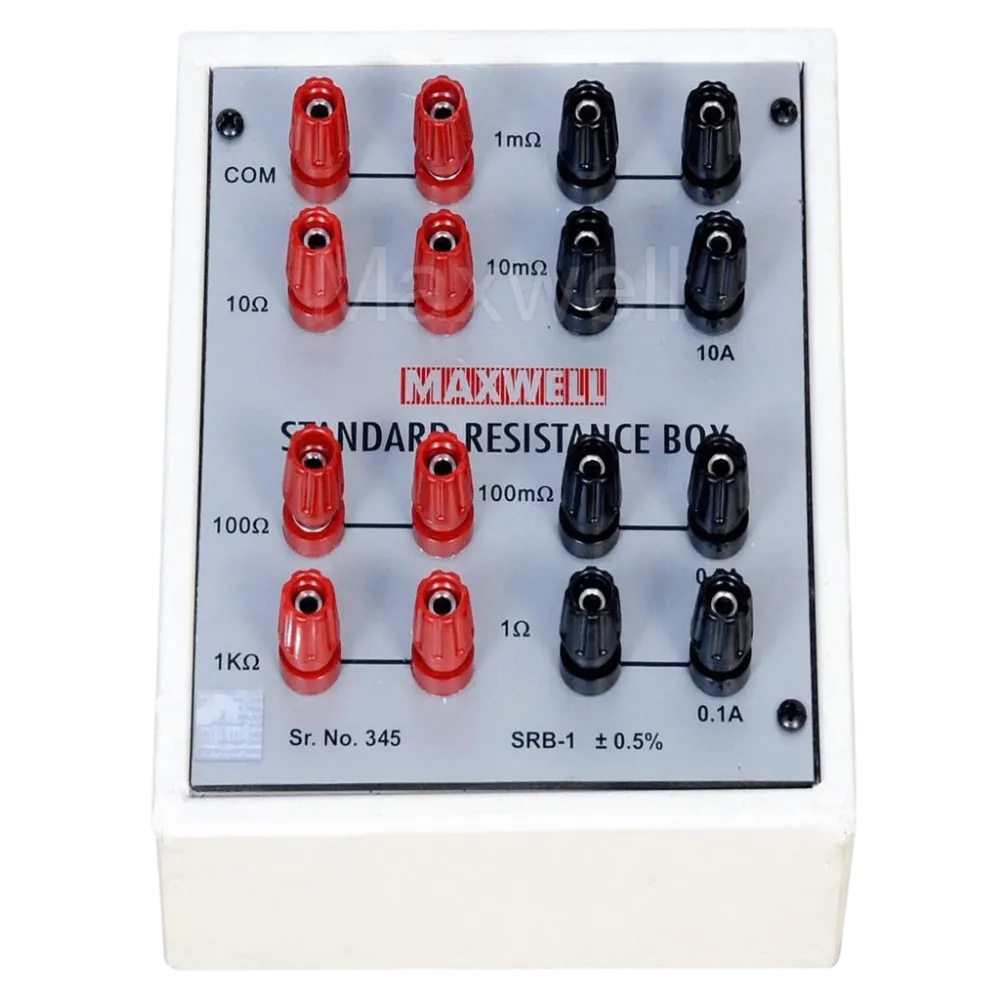
Micro-Ohm Meter
- Widely accepted in:
- IEC 60228 (conductor resistance)
- IEC 60909
- ASTM standards
- Utility and railway specifications
Both, Kelvin Double Bridge and Micro-ohm meters are calibrated by Standard Resistance Box. Thus ensuring long term stability and precise measurements.
Cost Comparison
| Factor | Kelvin Double Bridge | Micro-Ohm Meter |
|---|---|---|
| Initial cost | Moderate to high | Varies (entry to advanced) |
| Maintenance | High | Low |
| Training cost | High | Low |
| Operational cost | High | Low |
Over time, Micro-Ohm Meters offer better ROI.
Advantages and Limitations
Kelvin Double Bridge – Pros & Cons
Advantages
- High precision
- Ideal for reference measurements
- Long-term stability
- Manipulation is not possible
Limitations
- Manual operation
- Time-consuming
- Not portable
- Requires skilled personnel
Micro-Ohm Meter – Pros & Cons
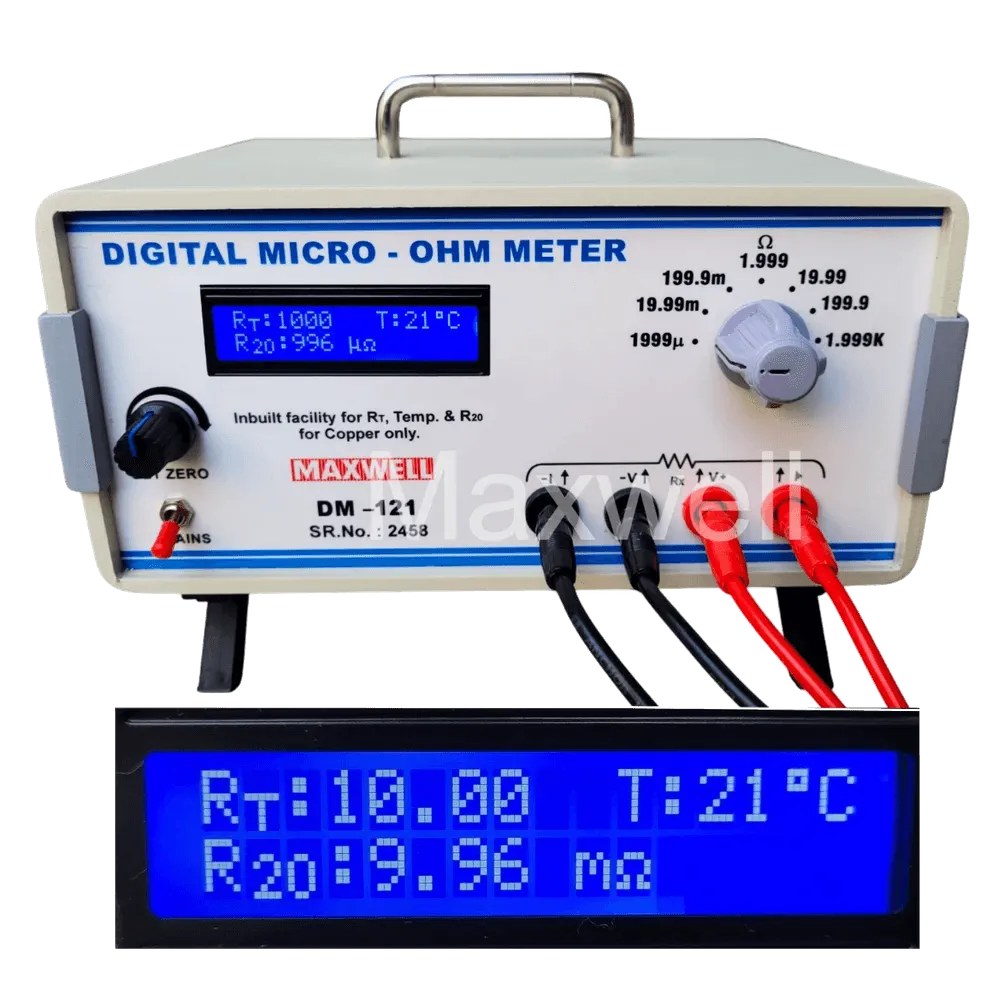
Advantages
- Fast and automatic
- Portable
- Digital display
- Data logging
- User-friendly
Limitations
- Depends on internal electronics calibration
- Entry-level models may have limited resolution
Which Instrument Should You Choose?
Choose Kelvin Double Bridge if:
- You are a calibration or standards laboratory
- You need reference-grade measurements
- Measurement speed is not critical
Choose Micro-Ohm Meter if:
- You perform routine testing
- You need fast and repeatable results
- You work in field or production environments
- You require data logging and reporting
Why Micro-Ohm Meters Are Replacing Kelvin Double Bridges
The shift towards Micro-Ohm Meters is driven by:
- Automation
- Digital traceability
- Reduced dependency on skilled operators
- Industry demand for faster testing
- On-site testing requirements
In modern electrical testing, speed, accuracy, and reliability together matter more than theoretical precision alone.
Conclusion
The Kelvin Double Bridge remains a respected and precise instrument for low-resistance measurement in laboratory environments. However, the Micro-Ohm Meter has become the industry standard due to its ease of use, speed, portability, and digital capabilities.
For most industrial, utility, and field applications, a Micro-Ohm Meter is the smarter and more practical choice, while Kelvin Double Bridge continues to serve as a benchmark in metrology labs.
Frequently Asked Questions (FAQs)
Is Kelvin Double Bridge more accurate than Micro-Ohm Meter?
In controlled laboratory conditions, yes. In practical applications, Micro-Ohm Meters provide more consistent results.
Can Micro-Ohm Meter replace Kelvin Double Bridge?
For most industrial and field applications, yes.
What is the typical range of Micro-Ohm Meter?
From micro-ohms (µΩ) up to several kilo-ohms depending on the model.
Why is four-wire method important?
It eliminates lead and contact resistance errors.
Which instrument is better for cable resistance testing?
Micro-Ohm Meter for on-site and Kelvin Double Bridge for Laboratory testing
Can Kelvin Double Bridge be used on-site?
Generally no. Kelvin Double Bridges are bench-top instruments and require stable environmental conditions, making them unsuitable for on-site testing.
Why is Kelvin Double Bridge still used today?
Kelvin Double Bridge is still used in calibration and metrology laboratories as a reference instrument due to its high precision and traceability. Also, a Kelvin Double bridge can’t be manipulated thus a preferred choice of quality inspectors as compared to Micro-ohm meter.
Which instrument is faster for low resistance measurement?
Micro-Ohm Meters provide results within seconds, whereas Kelvin Double Bridge measurements take significantly longer due to manual balancing.
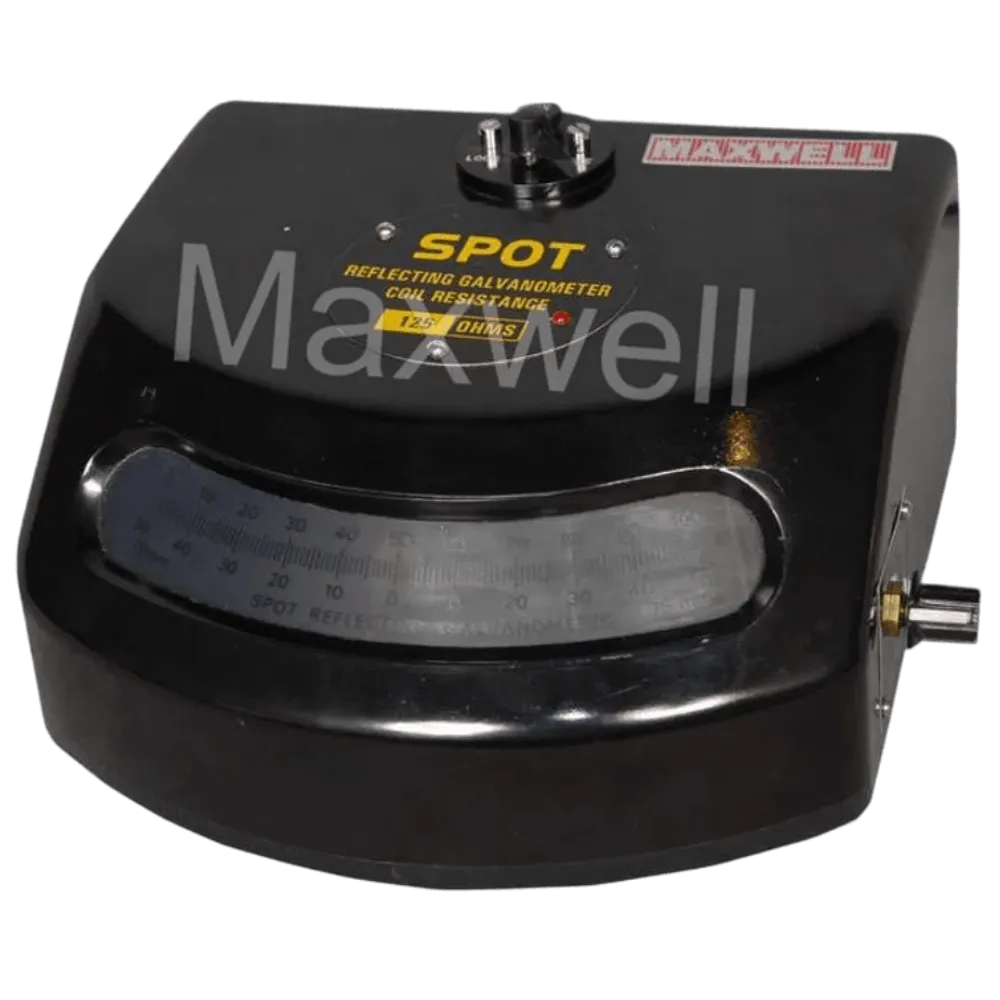
Does Micro-Ohm Meter use a galvanometer?
No. Micro-Ohm Meters use electronic amplifiers and high-resolution ADCs instead of galvanometers.
Are Kelvin Double Bridges affected by temperature?
Yes. Temperature variations can affect the resistance standards and balance accuracy of a Kelvin Double Bridge.
Does Micro-Ohm Meter work on AC or DC?
Micro-Ohm Meters use DC current to avoid inductive effects and ensure accurate resistance measurement.