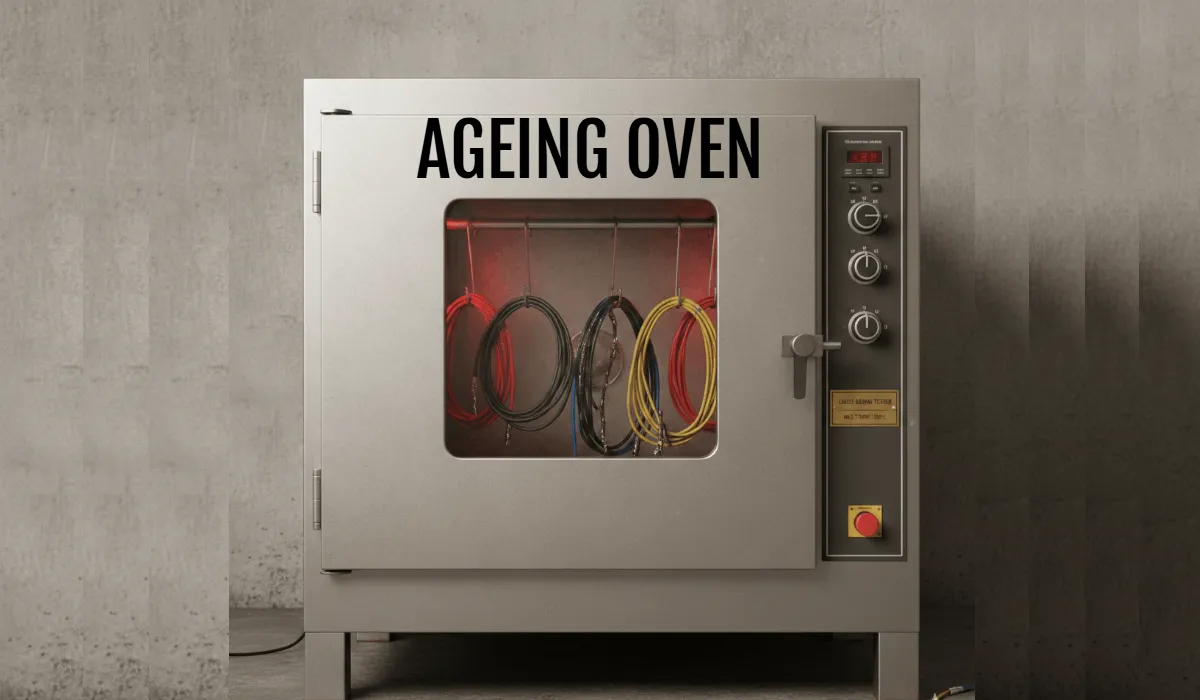
Ageing Oven – Complete Guide for Cable & Insulation Testing as per IS 10810
In the cable and wire industry, long-term performance is everything. A cable may look perfect today, but how will it behave after years of thermal stress? This is where an Ageing Oven becomes a critical laboratory instrument.
If you are a cable manufacturer, testing laboratory, EPC contractor, or quality inspector, understanding the correct use of an ageing oven is essential for compliance with Indian and international standards.
In this detailed guide, we will cover:
- What is an ageing oven?
- Why ageing tests are mandatory
- Ageing Oven as per IS 10810
- Construction & working principle
- Key technical specifications
- Common mistakes in ageing testing
- Advanced FAQs rarely discussed
- How to select the right ageing oven
What is an Ageing Oven?
An Ageing Oven is a precision laboratory heating chamber used to simulate long-term thermal exposure of cable insulation, sheath, rubber, PVC, XLPE, elastomers, and other polymeric materials.
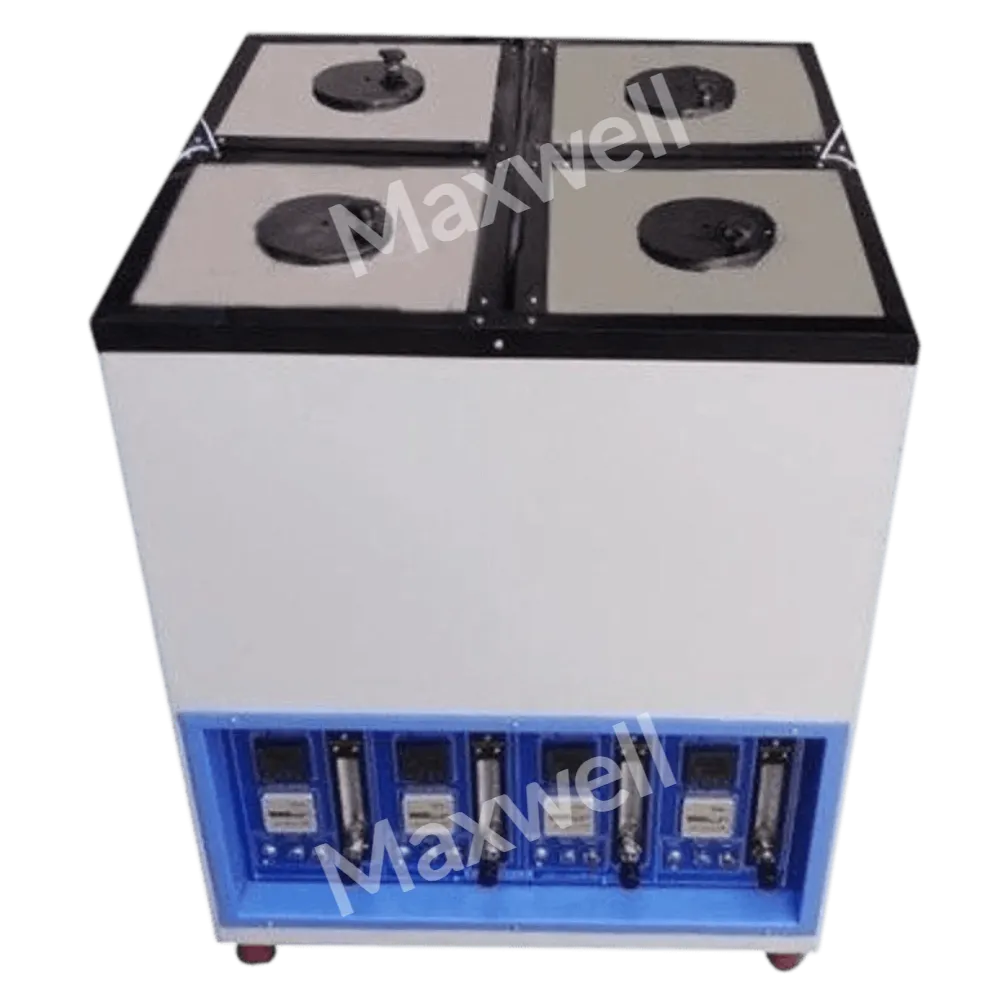
It is primarily used to perform ageing tests as per:
- Cable & Wire Standards : IS 10810, IS 694, IS 1554, IS 7098, IS 8130, IS 5831, IS 6380, IS 14697, IS 16442, IS 13360
- IEC standards : IEC 60227, IEC 60502, IEC 60811, IEC 60332, IEC 60216
- ASTM standards : ASTM D3045, ASTM D638, ASTM D2307, ASTM D573
- BS standards
The purpose is to determine:
- Retention of tensile strength
- Retention of elongation at break
- Resistance to thermal degradation
- Insulation stability under prolonged heat exposure
Why Ageing Testing is Critical in Cable Industry
Cables operate under heat due to:
- Current flow
- Ambient temperature
- Solar radiation (outdoor cables)
- Industrial environments
Over time, heat causes:
- Oxidation of polymers
- Loss of plasticizers
- Brittleness
- Cracks
- Reduction in mechanical strength
An ageing oven accelerates this process in a controlled environment, allowing manufacturers to predict long-term performance in a short time.
Ageing Oven as per IS 10810
The ageing oven used in cable laboratories must comply with requirements defined under IS 10810 (Methods of Test for Cables).
Important Test Conditions under IS 10810:
- Temperature range: Typically 70°C to 200°C (depending on material)
- Duration: 24 hours, 168 hours, or as specified
- Uniform air circulation
- Temperature stability within ±1°C or ±2°C
- Data logging functionality preferred by Cable Inspectors
- Adequate air changes per hour
Non-uniform heating leads to incorrect ageing results and test failures.
Construction of an Ageing Oven

A high-quality ageing oven consists of:
1. Double-Walled Construction
- Outer body: Powder-coated mild steel
- Inner chamber: Stainless steel (SS 304 preferred)
- Insulation: High-density mineral wool
2. Heating System
- Tubular air heaters
- Uniform distribution around chamber
3. Air Circulation System
- Forced air circulation fan
- Ensures temperature uniformity
- Prevents hot spots
4. Temperature Control System
- Digital PID controller
- High accuracy temperature sensor (PT100)
5. Safety Features
- Over-temperature cut-off
- Fuses and MCB
- Door gasket sealing
Working Principle of an Ageing Oven
The working principle is simple yet critical:
- Samples are suspended inside the chamber.
- Oven is set to a specific temperature.
- Heated air circulates uniformly.
- Samples are exposed for a defined duration.
- After ageing, samples are cooled.
- Mechanical properties are tested again.
Key Technical Specifications (Typical Industrial Model)
- Temperature range: Ambient +5°C to 200°C
- Accuracy: ±1°C
- Uniformity: ±2°C
- Timer: Digital programmable
- Air circulation: Forced convection
- Power: 230V AC / 50Hz
- Chamber size: Customizable
Types of Ageing Ovens
1. Natural Air Circulation Oven
- No internal fan
- Used for specific standards
- Slower heating
2. Forced Air Circulation Oven
- Most commonly used
- Uniform heating
- Faster stabilization
3. Air Change Type Oven (High-End)
- Controlled fresh air exchange
- Used for advanced compliance testing
FAQs in Ageing Testing
Now let’s discuss questions that are rarely asked but extremely important.
1. Does Air Velocity Affect Ageing Results?
Yes.
Higher air velocity can accelerate oxidation beyond standard limits. IS 10810 specifies air change requirements. Excessive airflow can produce unrealistic degradation.
2. Why Sample Position Inside Oven Matters?
Samples placed:
- Near heater → Over-aged
- Near door → Under-aged
- Near fan outlet → Higher oxidation
Proper sample suspension and spacing are critical.
3. Should the Oven Be Fully Loaded During Calibration?
No.
Calibration must simulate actual working load. An empty oven shows better uniformity than a loaded oven. Always validate with real sample load.
4. How Often Should an Ageing Oven Be Calibrated?
- Temperature calibration: Every 6 months
- Uniformity mapping: Annually
- Sensor verification: As per ISO 17025 lab norms
5. What Happens If Temperature Overshoots by 5°C?
Even 5°C overshoot can:
- Reduce elongation drastically
- Fail material artificially
- Invalidate test results
- Accuracy of 1°C via PID control is generally recommended
Polymer degradation is highly temperature-sensitive.
6. Can We Open the Door During Ageing?
Technically yes, but:
- Temperature drops
- Oxidation conditions change
- Time calculation becomes inaccurate
Best practice: Avoid opening during test cycle.
7. Why Door Gasket Quality Is Critical?
Poor gasket causes:
- Heat leakage
- Temperature fluctuation
- Increased power consumption
- Non-compliance in audits
8. How Does Altitude Affect Ageing Oven Performance?
At higher altitudes:
- Air density decreases
- Heat transfer changes
- Circulation effectiveness reduces
PID tuning may need adjustment.
9. Is Stainless Steel Mandatory for Inner Chamber?
For high-quality compliance testing — yes.
Mild steel inner chambers:
- Corrode
- Contaminate samples
- Affect long-term accuracy
10. Can Ageing Oven Be Used for Other Tests?
Yes, including:
- Thermal stability test
- Shrinkage test
- Conditioning before tensile test
- Rubber ageing
- PVC ageing
- Elastomer stability testing
Common Mistakes in Ageing Testing
- No pre-heating stabilization
- Overloading chamber
- Using uncalibrated thermometer
- Not recording actual temperature chart
- Ignoring air change requirement
- Using domestic oven instead of certified lab oven
How to Select the Right Ageing Oven
When selecting an ageing oven for your lab, consider:
1. Compliance
Must conform to IS 10810
2. Uniformity
Ask for temperature mapping data.
3. Air Circulation Design
Balanced airflow system preferred.
4. Controller Type
PID controller with auto-tuning.
5. After-Sales Support
Spare availability
Calibration support
AMC facility
Why Ageing Oven is Essential for NABL & BIS Labs
Testing laboratories accredited under ISO 17025 must:
- Use calibrated equipment
- Maintain temperature logs
- Ensure uniformity compliance
A reliable ageing oven ensures:
- Audit compliance
- Repeatable results
- Reduced sample rejection
Benefits of a High-Quality Ageing Oven
- Accurate simulation of service life
- Improved product reliability
- Compliance with national standards
- Reduced warranty claims
- Stronger brand reputation
Conclusion
An ageing oven is not just a heating chamber. It is a critical quality control instrument that determines whether your cable insulation will survive years of real-world stress.
Investing in a properly engineered ageing oven ensures:
- Accurate thermal ageing results
- Compliance with IS 10810
- Consistency in mechanical property retention
- Trust from clients and certification bodies
If you are manufacturing cables, wires, elastomers, or insulation materials, a precision ageing oven is not optional — it is essential.