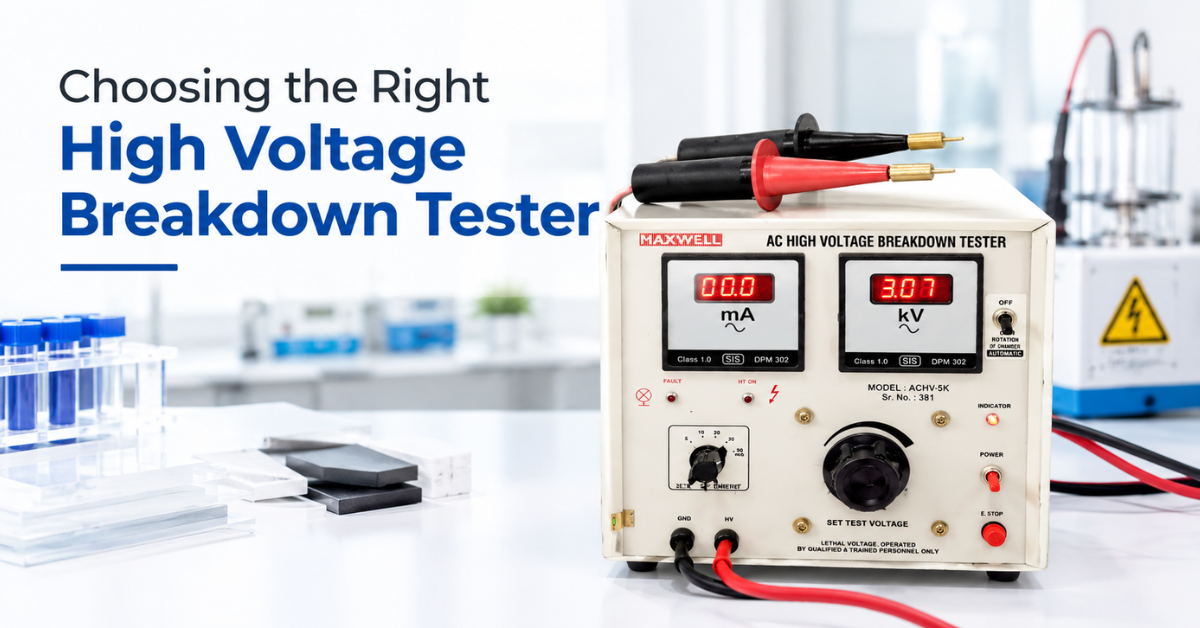
Insulation is only ever as good as its ability to actually hold up under stress — and there’s really only one way to know how much stress it can take: push it until it fails. That’s the whole job of a high voltage breakdown tester. It applies rising voltage to a cable, material, or component until the insulation gives way, showing you the real dielectric strength instead of a number you’re just assuming.
If you’re shopping for one, the AC-vs-DC question alone can throw people off, before you even get into voltage ranges, current settings, and safety features. So let’s walk through how these testers actually work and what genuinely matters when picking one.
What Is a High Voltage Breakdown Tester?
A high voltage breakdown tester — sometimes called a hipot tester or dielectric strength tester — applies a controlled high voltage to a cable, insulating material, or component to find out the maximum voltage it can withstand before its insulation fails.
This isn’t your routine pass/fail check at normal operating voltage. It’s a deliberate push well past normal conditions, meant to confirm there’s an adequate safety margin before actual failure. It’s standard practice in quality control for cables, polymers, rubber, plastics, and other insulating materials, and shows up constantly across cable and wire manufacturing, testing labs, and production floors.
How Does It Actually Work?
Ramping Up the Voltage
The tester raises voltage steadily on the material or component being tested, usually through a smooth, controlled ramp — a dimmerstat or something similar. Going gradually instead of jumping straight to high voltage is what lets you pinpoint the actual breakdown point accurately.
Watching the Leakage Current
As voltage climbs, a small leakage current starts flowing through the insulation. The tester keeps an eye on this continuously via a digital display, because a sudden spike in that current is usually the clearest sign that breakdown is happening — or about to.
Trip Protection
To keep both the operator and the setup safe, these instruments come with selectable tripping currents — once leakage current crosses a preset limit, the test cuts off automatically. That trip function, combined with fault indicators, is what turns this into a controlled test rather than a chaotic failure event.
Recording the Result
Whatever voltage the insulation actually fails at — or wherever leakage current crosses the trip threshold — gets recorded as the breakdown voltage. That number then gets checked against the material’s expected dielectric strength, or whatever standard applies, to decide pass or fail.
AC or DC? Here’s the Real Difference
This tends to be the first real fork in the road, and honestly it comes down entirely to what you’re testing and which standard governs it.
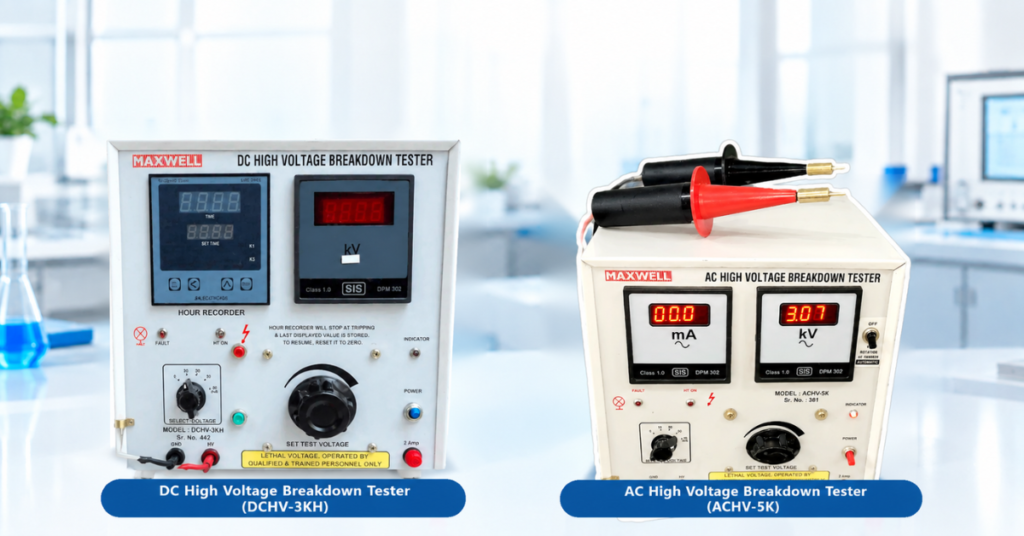
AC High Voltage Breakdown Testers
An AC high voltage breakdown tester applies alternating voltage, which mirrors the actual operating conditions most cables and insulation systems deal with in real use. It’s the go-to for dielectric withstand testing of cables and insulation systems, often aligned with standards like BIS 694. These units typically put out somewhere in the 5–10 kV range, with dual digital meters showing applied voltage and leakage current side by side.
DC High Voltage Breakdown Testers
A DC tester, on the other hand, applies a steady direct voltage — often the better choice for capacitive loads, longer cable runs, or cases where DC testing just reflects real application conditions more accurately. These usually follow standards like IS 694 when evaluating dielectric strength and insulation performance in cables, polymers, rubber, and plastics.
In a lot of labs, both types end up being used, depending on the material or standard in question. They’re not really interchangeable — insulation behaves noticeably differently under AC stress versus DC stress, so picking the wrong type can give you misleading results.
What Actually Matters When Choosing One
AC or DC — check the standard first
Don’t guess here. Look at what your product standard or test spec actually calls for, since some materials specifically require AC, others DC.
Voltage and current range
Make sure the output — commonly somewhere from 2 kV up to 10 kV or higher on request — and the leakage current range actually cover your testing needs, with a bit of headroom for bigger samples.
Leakage current monitoring and trip settings
Selectable tripping currents and a real-time leakage display aren’t just nice extras — they’re what keeps testing from turning into an uncontrolled failure.
How smooth is the voltage ramp
A steady, controllable ramp — whether it’s a manual dimmer or a motorized setup — gives you more accurate, repeatable readings than something that jumps unevenly.
Safety features
Given the voltages involved, fault indicators, audio/visual alarms, and automatic trip protection aren’t optional. A solid metal enclosure and clear controls matter too for everyday lab use.
Multi-channel testing, if volume matters
If you’re running a lot of samples, a multi-channel tester — letting you test several at once with independent voltage control — can seriously speed things up compared to doing them one by one.
Standards compliance
Confirm the instrument actually supports the standard relevant to your product — BIS 694 or IS 694, depending on whether you need AC or DC.
Where These Testers Actually Get Used
- Cable and wire manufacturing — confirming insulation dielectric strength before products ship
- Polymer and plastics testing — checking insulating materials used in cable sheathing and components
- Transformer and switchgear testing — making sure insulation systems can handle voltages well above normal operation
- R&D and QC labs — both routine and developmental dielectric testing
- Production batch testing — verifying insulation performance as part of ongoing manufacturing QC
Breakdown Testing vs. Insulation Resistance Testing
Worth drawing a clear line here, since the two often get used together but aren’t measuring the same thing.
An insulation resistance test — done with something like a megohmmeter or a million megohm meter — checks how much resistance the insulation puts up against current leakage at a relatively low test voltage. It’s non-destructive, just confirming the insulation is in good shape.
A breakdown test is a different animal entirely — deliberately pushing voltage up until something actually fails, to confirm the real safety margin before that happens. It’s more rigorous, and often destroys the sample in the process.
Most labs use both — insulation resistance for quick, non-destructive routine checks, and breakdown testing when they need to confirm actual dielectric strength margins during design validation or periodic audits.
High Voltage Breakdown Testers at Maxwell
Maxwellindia manufactures both AC and DC High Voltage Breakdown Testers built for dielectric strength testing of cables, polymers, rubber, plastics, and other insulating materials. The AC unit offers output up to 5 kV/30 mA (higher-voltage models available on request), dual digital meters for voltage and leakage current, selectable tripping currents, and either manual or optional motorized dimmer control. The DC High Voltage Breakdown Tester, built to IS 694, comes with a digital kV display and smooth dimmerstat-based voltage control, plus trip settings for safe, accurate testing. For labs running higher volumes, Maxwell also makes a DC High Voltage 5-Channel Breakdown Tester with independent voltage control and touchscreen operation across multiple channels.
Conclusion
Choosing the right high voltage breakdown tester really comes down to matching it to your actual testing standard — AC or DC — and making sure it has the voltage range, current monitoring, and safety features your work genuinely needs. Whether it’s cable insulation, polymers, or components headed for certification, a properly chosen breakdown tester gives you a real, repeatable way to confirm insulation can actually take the stress it’s rated for, instead of just hoping it can.
Frequently Asked Questions
1. What is a high voltage breakdown tester used for?
It applies rising voltage to a cable, material, or component to find the maximum voltage it can withstand before insulation breakdown, confirming its actual dielectric strength.
2. What’s the difference between AC and DC breakdown testers?
AC testers apply alternating voltage, closely matching real operating conditions. DC testers apply steady voltage, often preferred for capacitive loads, longer cables, or specific material standards.
3. Why does leakage current monitoring matter during breakdown testing?
A sharp rise in leakage current is one of the clearest signs insulation breakdown is underway, letting the test trip safely before an uncontrolled failure or damage occurs.
4. How does breakdown testing differ from insulation resistance testing?
Insulation resistance testing is a non-destructive check at low voltage confirming insulation quality. Breakdown testing deliberately raises voltage until failure, revealing the actual safety margin.
5. What standards govern high voltage breakdown testing in India?
Commonly BIS 694 and IS 694, depending on whether AC or DC testing applies and the specific product category involved.