Copper and aluminium conductors are only as good as their purity allows them to be. A conductor that looks fine, has the right dimensions, and passes a basic continuity check can still underperform electrically if its conductivity falls short of what’s expected. Catching this requires more than a simple resistance check — it requires a conductivity meter.
If you’re evaluating one for your lab or production line or inspection of raw materials in your factory, the choice isn’t always obvious. This guide covers what a conductivity meter actually measures, how it works, and the factors worth weighing before you choose one.
What Is a Conductivity Meter?
A conductivity meter is an instrument used to measure how well a material — typically copper or aluminium — conducts electricity, expressed as a percentage relative to a defined reference standard, commonly IACS (International Annealed Copper Standard).
Rather than just telling you the resistance of a sample, a conductivity meter tells you how that material’s conductivity compares to what’s expected for a pure, high-quality conductor of that type. This distinction matters a lot in manufacturing, where even conductors with acceptable resistance readings can have inconsistent or lower-than-expected conductivity due to impurities, poor annealing, or manufacturing defects.
How Does a Conductivity Meter Work?
Measuring Resistance First
At its core, conductivity is derived from resistance. The instrument measures the resistance of the conductor sample using a precise, low-resistance measurement method — typically the 4-terminal Kelvin method, which eliminates errors from lead and contact resistance.
Accounting for Dimensions
Conductivity depends not just on resistance but also on the physical dimensions of the sample — its length and cross-sectional area (or diameter, in the case of wires and rods). The instrument takes these inputs, either entered manually or measured directly, to calculate resistivity from the raw resistance reading.
Comparing Against a Reference Standard
Once resistivity is known, the instrument compares it against the reference resistivity of a standard material — commonly annealed copper — to express the result as a percentage conductivity (%IACS). This is the number that actually tells you how the material performs relative to expectation.
Temperature Compensation
Conductivity, like resistance, changes with temperature. A meter with an inbuilt temperature sensor and automatic temperature compensation calculates the equivalent conductivity at a standard reference temperature (usually 20°C), so readings taken under different ambient conditions can still be compared reliably.
Key Applications of a Conductivity Meter
Conductivity testing shows up wherever conductor quality directly affects product performance:
- Wire and rod manufacturing — verifying copper or aluminium wire and rod meets required conductivity before further processing
- Busbar and strip testing — checking conductivity of flat conductors used in power distribution and switchgear
- Incoming material inspection — confirming raw conductor stock meets specification before it’s accepted into production
- Quality control and compliance testing — supporting conformance to relevant Indian Standards for conductor materials
- Failure analysis — identifying whether reduced conductivity is contributing to a product performance issue
Types of Conductivity Meters Based on Application
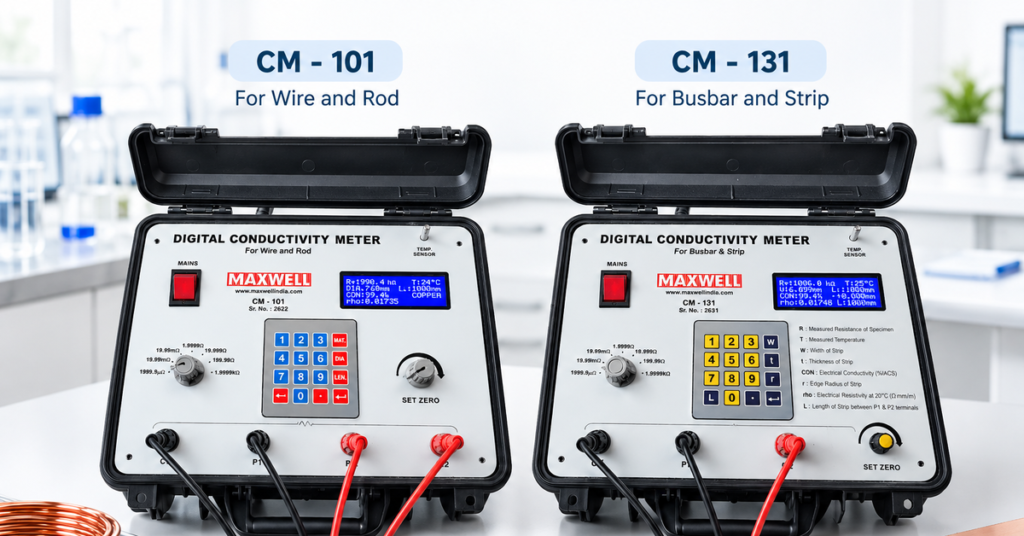
Conductivity Meters for Wire and Rod
These are designed specifically to test cylindrical conductors — wires and rods — where the input required is typically diameter and length. They’re commonly used in wire drawing and rod manufacturing lines to confirm conductivity at various stages of processing.
Conductivity Meters for Busbar and Strip
Flat conductors like busbars and strips need a different measurement configuration to accommodate their shape. These instruments are built with terminal arrangements suited to flat or rectangular cross-sections, often used in switchgear and power distribution component manufacturing.
Both types generally rely on the same underlying 4-terminal Kelvin measurement principle, with the physical test fixture adapted to the sample geometry.
Note: There are other types of Conductivity meters also available in the market which runs on the concept of eddy currents. These conductivity meters check the conductivity of a certain point, so in case the sheet or busbar has uneven purity then the eddy current conductivity meter won’t give correct readings as the probe will give conductivity of a certain point and not the complete sheet. Also eddy current conductivity meters are not reliable to check conductivity of a wire/rod as they need a flat surface to work on. While Maxwell’s conductivity meter works on electrical resistance value thus it is more effective and give stable readings as compared to eddy current conductivity meter.
Key Factors to Consider When Choosing a Conductivity Meter
1. Sample Type and Geometry
Start with what you’ll actually be testing. Wire and rod samples need a different fixture than busbars and strips, so choose an instrument designed for the conductor geometry you work with most. The value of conductivity can be increased if you make a proper holding arrangement with very tight grips.
2. Measurement Method
Confirm the instrument uses a genuine 4-terminal Kelvin measurement setup. This is essential for accurate low-resistance readings, which directly affect the accuracy of the derived conductivity value.
3. Test Current
A higher test current at lower resistance ranges generally produces a more stable, measurable voltage drop, which improves reading consistency — particularly important for high-conductivity materials like copper & aluminium.
4. Temperature Compensation
Since conductivity readings are temperature-sensitive, an inbuilt temperature sensor with automatic compensation to a standard reference temperature(i.e.20°C) as per IS 8130 saves time and reduces the risk of manual calculation errors.
5. Display and Interface
A clear digital display — ideally backlit for use in varying lighting conditions — along with a straightforward keypad interface, makes routine testing faster and reduces misreadings during high-volume checks.
6. Standards Compliance
For manufacturing quality control, it’s worth confirming the instrument is designed to support testing in line with the relevant Indian Standards applicable to your conductor type, such as those covering copper and aluminium conductors used in cables, busbars, and electrical equipment.
7. Build and Portability
Consider whether the instrument will stay at a fixed test bench or move around a facility. A rugged, portable design with a carry case is useful for field or multi-location testing, while a bench-top design suits a dedicated lab setup.
Conductivity Meter vs. Micro-Ohm Meter: What’s the Difference?
These two instruments are related but answer different questions.
A micro-ohm meter measures the actual resistance of a conductor in ohms — useful for confirming a cable or component meets a specific resistance limit.
A conductivity meter goes a step further, using resistance along with the sample’s dimensions to calculate how conductive the material is relative to a reference standard, expressed as %IACS. This tells you something about the material quality itself, not just the resistance of that particular sample.
In many testing setups, both instruments are used together — resistance measurement to check the conductor against a resistance specification, and conductivity measurement to verify the material quality behind it.
Where Conductivity Testing Fits in Overall Quality Control
Conductivity testing rarely stands alone. It’s typically part of a broader testing sequence that may include:
- Conductor resistance measurement, to confirm the sample meets resistance specifications
- Insulation resistance testing, to check that surrounding insulation is intact
- Dimensional checks, since conductivity calculations depend on accurate diameter or cross-sectional measurements
Together, these tests confirm that a conductor is not just dimensionally correct, but electrically sound and made from material of the expected quality.
Conductivity Meters at Maxwell
Maxwellindia manufactures conductivity meters (CM-101 & CM-131) designed for both wire and rod testing and busbar and strip testing, using the 4-terminal Kelvin measurement method with an inbuilt temperature sensor for automatic compensation. These instruments feature a backlit LCD display, keypad-based operation, and a rugged, portable enclosure, making them suited to both laboratory and field conductivity testing in the cable and electrical manufacturing industry.
Conclusion
Choosing the right conductivity meter comes down to matching the instrument to what you’re actually testing — the sample geometry, the measurement method, and the level of precision your quality process demands. Whether you’re checking wire and rod stock or busbar and strip material, a conductivity meter built on the 4-terminal Kelvin method with proper temperature compensation gives you a reliable way to confirm that your conductors aren’t just the right size, but genuinely meet the electrical performance expected of them.
Frequently Asked Questions
1. What does a conductivity meter actually measure?
It measures how well a material conducts electricity, expressed as a percentage relative to a reference standard like IACS, calculated from the material’s resistance and dimensions.
2. How is a conductivity meter different from a resistance meter?
A resistance meter measures the resistance of a specific sample in ohms. A conductivity meter uses that resistance, along with the sample’s dimensions, to calculate how conductive the material itself is compared to a standard.
3. Why is temperature compensation important in a conductivity meter?
Conductivity readings change with temperature, so automatic compensation to a standard reference temperature (i.e.20°C) as per IS 8130 ensures readings remain consistent and comparable regardless of ambient conditions.
4. Can the same conductivity meter test both wires and busbars?
It depends on the instrument’s fixture design. Meters built for wire and rod use different terminal arrangements than those built for flat busbars and strips, so it’s important to choose one suited to your sample geometry. Also, Maxwell provides standard 1 meter Wooden attachment for fixing of wire/rod/busbar/sheet sample thus proper connectivity is ensured.
5. Where is conductivity testing commonly used?
It’s widely used in wire and rod manufacturing, busbar and strip production, incoming material inspection, and general quality control for copper and aluminium conductors.