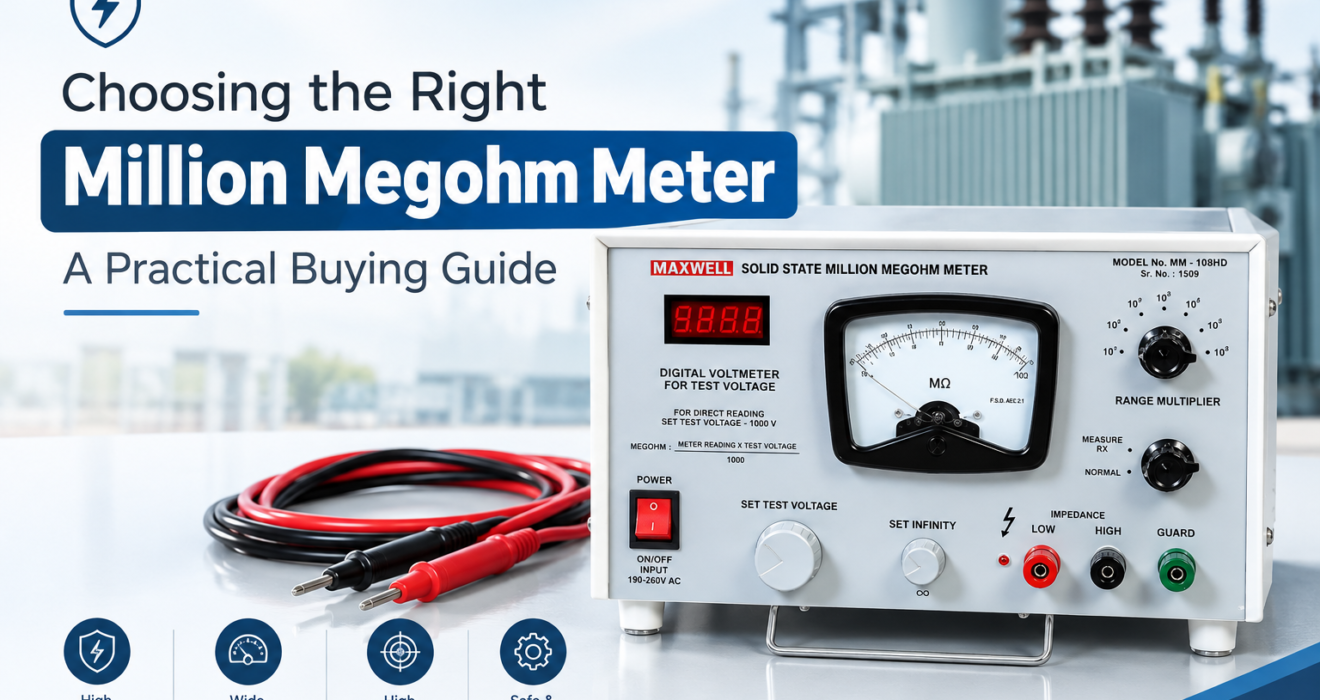
Insulation failure rarely gives much warning. A cable, transformer, or motor winding can look perfectly fine on the outside while the insulation underneath has quietly degraded to a point where it’s about to fail. The only reliable way to catch this before it becomes a real problem is by measuring insulation resistance — and for very high resistance ranges, that means reaching for a million megohm meter.
If you’re in the market for one, the sheer range of specifications and models can get confusing fast. This guide walks through what a million megohm meter actually does, how it works, and what really matters when you’re choosing one for lab or industrial use.
What Is a Million Megohm Meter?
A million megohm meter — often just called a meg-ohm meter or insulation resistance tester — is a specialized instrument designed to measure extremely high resistance values, well beyond what a standard multimeter or even a general megohmmeter can handle. It’s built specifically to test the insulation resistance of materials and components where resistance is expected to be in the range of megohms, gigohms, or even tera-ohms.
This matters because insulation is only doing its job if it offers extremely high resistance to current flow. The moment that resistance starts dropping, it’s a sign the insulation is breaking down — from moisture ingress, aging, contamination, or physical damage.
How Does a Million Megohm Meter Work?
The working principle is fairly straightforward, even though the measurement itself requires careful engineering.
Applying a High DC Test Voltage
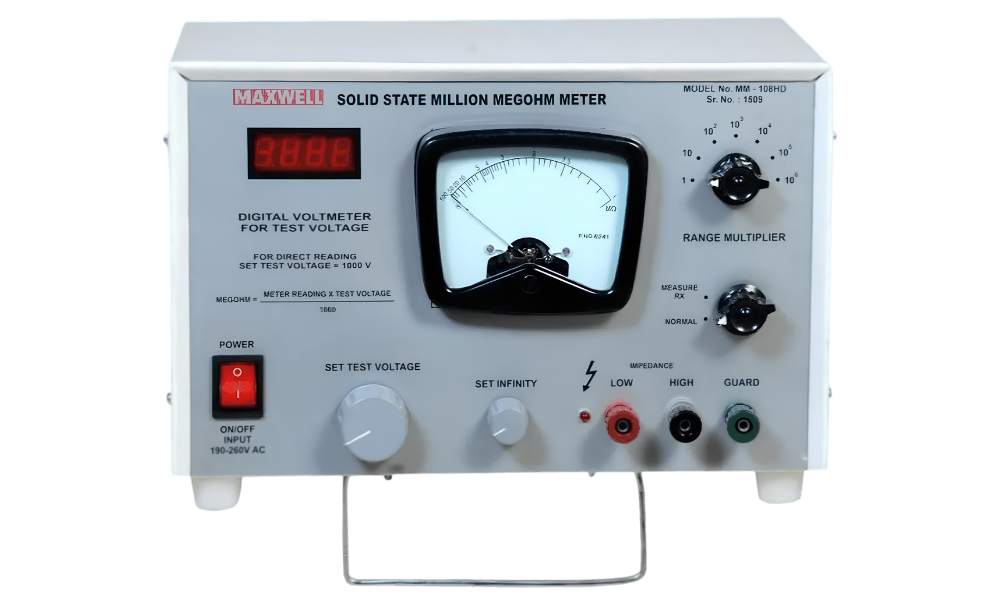
The instrument applies a controlled DC test voltage across the material or component being tested. Since insulation resistance is meant to be extremely high, a low test voltage wouldn’t generate a current large enough to measure accurately. That’s why these instruments typically offer an adjustable voltage range — Maxwell’s MM-108D, for instance, offers a test voltage range of 70–600V DC with fine adjustment, letting the operator match the voltage to the material and standard being followed.
Measuring the Resulting Leakage Current
Once voltage is applied, a very small leakage current flows through the insulation. The instrument measures this current with high sensitivity and, using Ohm’s Law, calculates the resistance value.
Digital Display and Resistance Calculation
The calculated resistance is shown on a digital display, often in ranges going up to hundreds of millions of megohms — which is where the “million megohm” name comes from. The MM-108D, for example, measures from 1 megohm up to 1×10⁸ megohms, equivalent to 100 tera-ohms, with a resistance accuracy of ±5% and voltage accuracy of ±1%.
Short-Circuit Protection
Because these instruments work at elevated voltages, built-in short-circuit protection is an important safety feature. It protects both the instrument and the operator if the material being tested unexpectedly breaks down during the test.
Why Insulation Resistance Testing Matters
Insulation resistance testing isn’t just a checkbox exercise — it directly affects safety and equipment life.
- Preventing electrical failures — degraded insulation can lead to short circuits, equipment damage, or fire hazards
- Ensuring personnel safety — poor insulation increases the risk of electric shock during operation or maintenance
- Extending equipment life — catching insulation degradation early allows corrective action before a full failure occurs
- Meeting quality and compliance requirements — insulation testing is a standard part of quality control in cable, transformer, and motor manufacturing
Key Factors to Consider When Choosing a Million Megohm Meter
1. Resistance Measurement Range
This is the first thing to check. Make sure the instrument’s range comfortably covers the resistance values you expect to measure — not just at the low end, but at the high end too. Testing high-quality insulation materials or specialized dielectrics may require measurement well into the tera-ohm range, so don’t choose an instrument that just barely covers your typical readings.
2. Test Voltage Range and Adjustability
Different materials and standards call for different test voltages. A meter with a wide, adjustable voltage range — ideally with fine adjustment rather than fixed steps — gives you the flexibility to match the test voltage precisely to your application and the relevant standard.
3. Accuracy
Look closely at both resistance accuracy and voltage accuracy specifications. These two numbers together determine how reliable your final readings will be, especially near the extreme ends of the measurement range.
4. Safety Features
Since testing involves elevated DC voltages, short-circuit protection isn’t optional — it’s essential. Check that the instrument you’re considering has this built in, along with a stable, well-insulated enclosure.
5. Display and Ease of Use
A clear digital display for both voltage and resistance readings makes a real difference during repetitive testing. It reduces the chance of misreading values and speeds up routine quality checks.
6. Application Fit
Think about what you’ll actually be testing most often — cable insulation, transformer and motor windings, or dielectric materials in R&D. While most million megohm meters can handle a range of applications, it’s worth confirming the instrument’s design suits your primary use case, especially in terms of test lead configuration and portability.
Common Applications of a Million Megohm Meter
These instruments are used across several industries where insulation quality is critical:
- Transformer and motor coil testing — verifying that winding insulation hasn’t degraded
- Cable insulation quality assessment — checking cable insulation as part of manufacturing QC or field maintenance
- Material dielectric property testing — evaluating insulating materials during R&D or material qualification
- Scientific and industrial research — measuring ultra-high resistance in specialized experimental setups
Million Megohm Meter vs. Standard Megohmmeter
It’s worth clarifying the difference here, since the terms sometimes get used loosely.
A standard megohmmeter typically measures insulation resistance in the range of a few hundred megohms to a few thousand megohms, which is sufficient for most routine cable and equipment insulation checks.
A million megohm meter is built for situations where you need to measure resistance values far beyond that — into the hundreds of millions of megohms or tera-ohm range. This level of sensitivity is generally needed for testing very high-quality insulating materials, specialized dielectrics, or components where even a tiny drop in resistance could indicate a meaningful problem.
If your routine testing rarely goes beyond standard megohm ranges, a conventional megohmmeter may be all you need. But for material research, high-voltage insulation systems, or applications demanding extremely high sensitivity, a dedicated million megohm meter is the right tool.
How This Fits Into a Broader Testing Setup
Insulation resistance testing is usually just one part of a complete electrical quality assessment. It’s often paired with:
- Conductor resistance measurement using a micro-ohm meter, to confirm the conductor itself meets resistance specifications
- High voltage breakdown testing, to check the dielectric strength of insulation under AC or DC stress
- Conductivity testing, particularly in cable and busbar manufacturing
Together, these tests give a complete picture — confirming both that current flows correctly where it should (through the conductor) and that it doesn’t leak where it shouldn’t (through the insulation).
Million Megohm Meters at Maxwell
Maxwellindia manufactures the MM-108D Million Megohm Meter, designed for high-precision insulation resistance testing up to 100 tera-ohms, with an adjustable DC test voltage range of 70–600V, digital voltage display, and built-in short-circuit protection. It’s suited for transformer and motor coil testing, cable insulation assessment, dielectric material testing, and industrial R&D applications where standard megohmmeters simply don’t offer enough range or sensitivity.
Conclusion
Choosing the right million megohm meter comes down to matching the instrument’s resistance range, voltage adjustability, accuracy, and safety features to what you actually need to test. For routine insulation checks, a standard megohmmeter may suffice — but for high-sensitivity applications like specialized dielectric testing or material research, a dedicated million megohm meter gives you the range and precision that lower-capacity instruments simply can’t match. Taking the time to match the specifications to your actual application pays off in more reliable readings and fewer surprises down the line.
Frequently Asked Questions
1. What is a million megohm meter used for?
It’s used to measure extremely high insulation resistance values, often into the hundreds of millions of megohms or tera-ohm range, for applications like transformer winding testing, cable insulation assessment, and dielectric material research.
2. How is a million megohm meter different from a regular megohmmeter?
A standard megohmmeter typically covers a few thousand megohms, suitable for routine insulation checks. A million megohm meter measures much higher resistance values, needed for specialized, high-sensitivity insulation testing.
3. What test voltage should I use for insulation resistance testing?
The appropriate test voltage depends on the material and applicable standard being followed. Instruments with an adjustable voltage range, like 70–600V DC, allow you to match the voltage to your specific testing requirement.
4. Why is short-circuit protection important in a million megohm meter?
Since testing involves elevated DC voltages, short-circuit protection safeguards both the operator and the instrument if the material under test suddenly breaks down during the measurement.
5. Can a million megohm meter be used for cable insulation testing?
Yes, it’s commonly used to assess cable insulation quality, especially where very high resistance values need to be confirmed as part of manufacturing quality control or material evaluation.
6. What can you do if your Million megohm meter is not showing correct readings?
Insulating the water bath with rubber pads at the bottom can help give stable readings in the Million Megohm meter. This helps in removing any interference with the actual insulation value reading in the meter.