Travelling Microscope: A Buyer’s Guide for Precision QC Laboratories
In quality control (QC) environments where sub-milli meter accuracy determines product compliance, the travelling microscope remains one of the most reliable optical measurement instruments. Despite the rise of digital vision systems, it continues to be widely used in calibration labs, educational research, and industrial inspection setups due to its simplicity, repeatability, and cost-effectiveness.
If you are planning to procure one, understanding travelling microscope reading, least count of travelling microscope, pricing, and manufacturers is essential before making a purchase decision.
What is a Travelling Microscope?

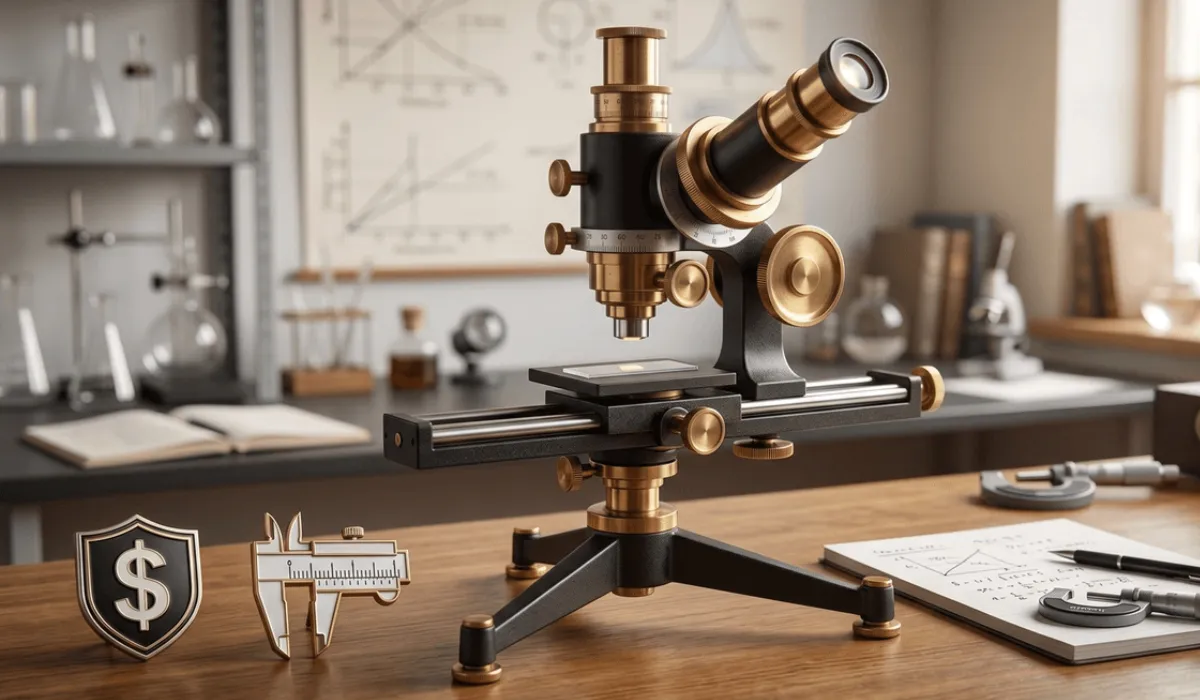
A travelling microscope is a precision optical instrument mounted on a sliding carriage that moves along horizontal and/or vertical scales. It is primarily used for measuring small linear displacements, diameters, and positional differences with high accuracy.
- It consists of:
- A microscope with cross-hair graticule
- A vernier scale for fine measurement
- Horizontal & vertical motion slides
- Fine adjustment screws
The instrument allows both coarse movement (sliding) and fine movement (micrometer screw) to achieve highly accurate positioning.
Why Travelling Microscope is Used in QC Labs
Unlike standard microscopes, a travelling microscope is not just for observation—it is a measurement instrument.
Key Applications:
- Measurement of wire diameter, small components, and thickness
- Determination of refractive index (optics labs)
- Surface tension & capillary rise experiments
- Calibration of scale displacement and alignment
- Liquid level measurement in manometers
In QC labs, it is particularly valued because:
- It provides repeatable mechanical measurement (no dependency on software)
- Ideal for low-volume, high-precision inspections
- Works reliably in non-digital environments
Travelling Microscope Reading & Least Count
Understanding travelling microscope reading is critical for accurate usage.
How Reading Works:
- Main scale gives coarse reading
- Vernier scale gives fine reading
- Final reading = Main scale + Vernier reading
Least Count of Travelling Microscope
The least count of travelling microscope (LC) determines the smallest measurable value.
Typical values:
- 0.01 mm (standard QC requirement)
- 0.02 mm (basic lab use)
Commercial instruments commonly offer 0.01 mm or 0.02 mm resolution, ensuring reliable precision measurements. These days, travelling microscope comes with digital vernier scale thus it becomes easier for an operator to get the readings quickly and more accurately eliminating the issue of manual error in the process.
👉 Note: Theoretical scale division may be ~0.5 mm, but vernier improves resolution significantly & digital further improves the resolution.
Key Buying Parameters (Critical for QC Labs)
When selecting a travelling microscope, avoid generic catalog selection. Focus on these engineering-grade parameters:
1. Least Count (LC)
- QC Labs: 0.01 mm mandatory
- Academic labs: 0.02 mm acceptable
2. Travel Range
- Horizontal: ~200–220 mm
- Vertical: ~150 mm
- Ensure it matches your component size
3. Optical Quality
- Achromatic lenses preferred
- Cross-line reticle must be sharp and stable
4. Mechanical Stability
- Heavy cast iron base is critical
- Smooth sliding without backlash
5. Fine Adjustment Mechanism
- Dual slow-motion knobs preferred
- No jerks or drift during measurement
6. Magnification
- Typical: 10x eyepiece
- Optional higher objectives for finer work
7. Calibration & Traceability
- Ask for:
- Calibration certificate
- NABL traceability (for QC compliance)
8. Build Material
- Brass + stainless steel components increase life
- Avoid plastic-heavy constructions
9. After-Sales Support
- Spare availability is critical (often ignored)
Travelling Microscope Price & Cost in India
The travelling microscope price varies widely based on build quality and precision.
Typical Price Range (India):
- Entry-level: ₹2,500 – ₹4,500
- Standard lab models: ₹4,500 – ₹7,000
- High precision / industrial models: ₹10,000 – ₹45,000
Example:
- Basic model: ~₹4,700 with 0.01 mm LC
👉 For QC labs, avoid ultra-cheap units—they often suffer from:
- Scale backlash
- Poor optical alignment
- Unreliable vernier readings
Travelling Microscope Manufacturers in India
India has a strong manufacturing base for lab instruments, especially in Ambala Cantt (Haryana)—a well-known hub.
Top Travelling Microscope Manufacturers:
- Maxwell Scientific Corporation
- Zoom Scientific World
- Satrun Meditech
- Standard Steel (Ambala)
- H. L. Scientific Industries
- Radical Scientific Equipments Pvt. Ltd.
- Micro Teknik
- Ajanta Export Industries
- Bluefic Industrial & Scientific Technologies
- Zoom Scientific World
- JLab Export
- Nvis Technologies (Indore)
👉 Ambala cluster dominates due to:
- Legacy manufacturing ecosystem
- Export-oriented production
- Competitive pricing
Industries Using Travelling Microscopes
While often associated with academic labs, the instrument has real industrial relevance:
Key Industries:
- Cable & conductor manufacturing (diameter QC)
- Metallurgy & materials testing
- Electronics & PCB inspection
- Glass & optics industry
- Pharmaceutical R&D labs
- Calibration laboratories
- Educational & research institutes
Travelling Microscope vs Digital Measurement Systems
| Parameter | Travelling Microscope | Digital Vision System |
|---|---|---|
| Cost | Low | High |
| Accuracy | High (manual) | Very high |
| Repeatability | Operator dependent | Automated |
| Maintenance | Low | High |
| QC Suitability | Excellent for basic QC | Ideal for high throughput |
👉 For SMEs and QC labs, travelling microscopes still offer the best ROI.
Common Mistakes Buyers Make
- Choosing based only on travelling microscope cost
- Ignoring least count of traveling microscope
- Not checking mechanical smoothness
- Skipping calibration requirement
- Buying from traders instead of manufacturers
Expert Buying Recommendation
If you are setting up or upgrading a QC lab:
- Choose 0.01 mm least count travelling microscope
- Prefer Ambala-based manufacturers
- Insist on calibration certificate
- Test smooth motion before purchase
- Avoid ultra-lightweight units
Conclusion
The travelling microscope remains a precision workhorse instrument—especially for QC labs that need accurate, repeatable, and cost-effective measurement solutions.
While digital systems are gaining popularity, a well-built travelling microscope still delivers:
- Reliable readings
- Low maintenance
- Excellent value for money
For buyers, the key is not just understanding travelling microscope price, but evaluating:
👉 least count, build quality, manufacturer credibility, and application fit