Comparative Tracking Index (CTI) Test: What It Is, Why It Matters & How It Works
📌 Learn about CTI testing, how to use CTI instruments, key applications, industries that need it, standards involved, and FAQs — all in one place.
👉 YouTube Insight:
Watch an illustrative video about the CTI test here:
Introduction: What Is the Comparative Tracking Index (CTI)?
The Comparative Tracking Index (CTI) is a standardized measure that quantifies the ability of an electrically insulating material to resist electrical tracking — a form of surface breakdown that can form conductive paths under electrical stress, moisture, and contamination. CTI is expressed in volts (V) and is used to evaluate how well a material can withstand surface arcing without forming a conductive path that could lead to short circuits or fire hazards.
In simple terms, CTI answers the question:
👉 At what voltage does this insulating material start to fail due to surface tracking?
Why Is Comparative Tracking Index Used?
Ensuring Electrical Safety
CTI testing is critical for preventing electrical hazards like arcing, surface breakdown, and short circuits in electrical equipment. It helps engineers and safety professionals determine how insulating materials behave when exposed to wet or contaminated conditions — situations that often occur in real-world operational environments.
Optimizing Design
Knowing the CTI of a material allows designers to calculate the minimum required creepage distance — the shortest path along the surface between two conductive parts — which directly influences product size and safety. Higher CTI means a shorter required creepage distance, enabling compact designs without compromising safety.
Material Selection and Benchmarking
CTI helps in comparing insulation materials against each other during material selection, quality control, and procurement processes, ensuring that only materials with acceptable tracking resistance are used in critical applications.
What Is Tracking? (Tracking Index Explained)
Tracking refers to the surface electrical breakdown of an insulating material caused by electrical stress and contaminated conditions (like moisture or dirt). When a high voltage is applied, minute tree-like carbon paths — also called electrical tracks — form on the insulator surface. These conductive paths eventually bridge the gap between electrodes, leading to a short circuit.
The Comparative Tracking Index (CTI) is the voltage level at which a material can endure 50 successive drops of electrolyte solution (usually 0.1% ammonium chloride) without forming such tracks. This makes CTI a reliable indicator of surface electrical performance under stressed conditions.
Standards That Govern CTI Testing
CTI testing follows international and regional standards that define how the test should be performed and how results are interpreted:
📌 IEC 60112
- International standard that specifies the method for determining both Proof Tracking Index (PTI) and Comparative Tracking Index (CTI) of solid insulating materials.
- Widely referenced in many electrical safety standards and product certifications.
📌 ASTM D3638 & D5288
- American standard equivalent for CTI testing, commonly used in North American labs for evaluating insulation against tracking.
📌 UL 746A & UL 840
- UL standards that incorporate CTI into material classification and creepage requirements.
📌 Indian Standards
- IS 13252 – for the safety of Information Technology Equipment (ITE)
- IS 16242 – for the safety and performance of Uninterruptible Power Systems (UPS) and inverters
📌 Other Standards
- Many IEC product standards (e.g., IEC 60335, IEC 61010, IEC 60950, etc.) reference CTI test results for safety compliance.
How CTI Testing Works — Step-by-Step
CTI testing involves simulating a contaminated environment under electrical stress to see how the material behaves. Here’s how the process typically works:
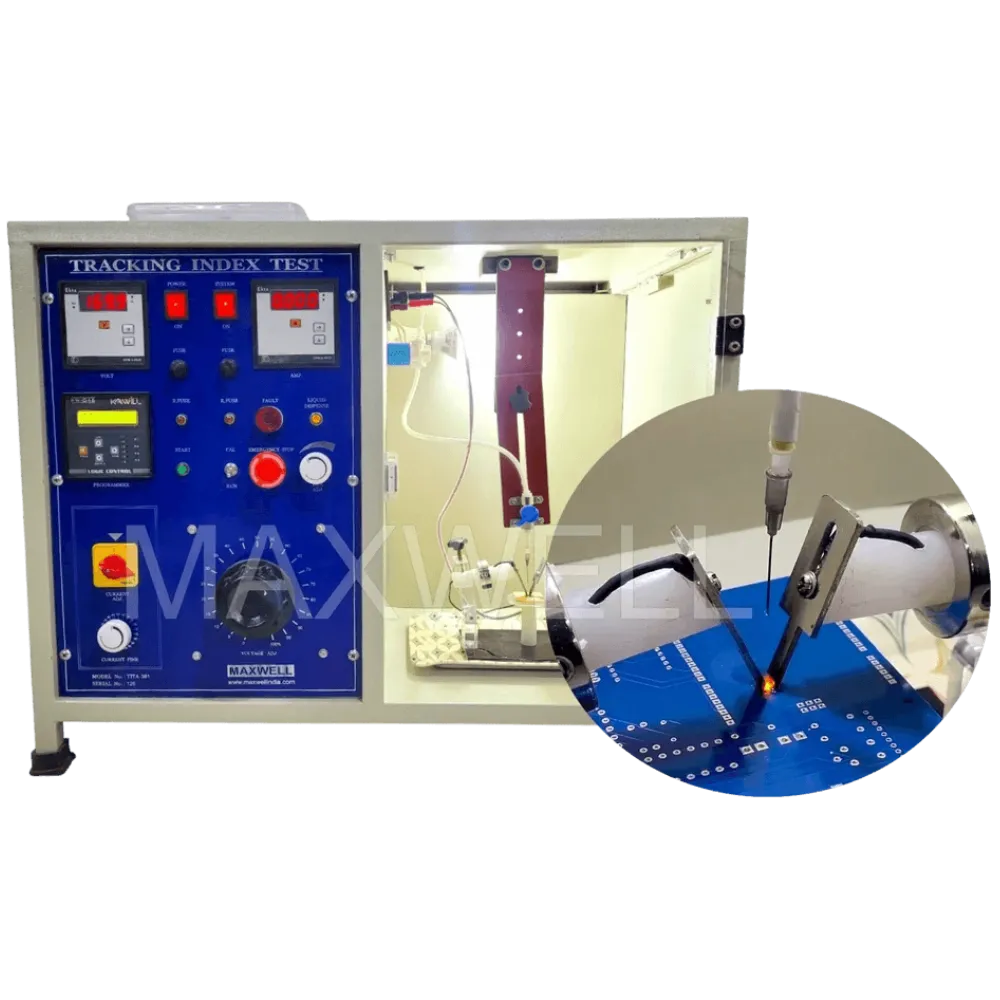
1. Specimen Preparation
- Insulating material samples of at least 3 mm thickness are prepared.
- At least five test sites on each sample are used for reliable data.
2. Electrode Material
- Two electrodes are placed at a fixed gap on the material surface.
- Platinum Electrodes as per ASTM D3638. It is technically equivalent to IEC 60112.
- Electrolytic Copper electrodes with a purity typically ~99.9% as per ASTM D5288
3. Apply Electrolyte
- Drops of a standardized solution (typically 0.1% ammonium chloride) are applied every 30 seconds to simulate contaminated conditions.
4. Apply Voltage
- A test voltage starting from a base level is applied across the electrodes.
- The voltage is increased in steps (e.g., 25 V increments) until tracking occurs or a maximum defined voltage is reached.
5. Determine CTI
- The highest voltage level at which the material withstands 50 drops without tracking is recorded as its CTI value.
Proof Tracking Index (PTI) vs Comparative Tracking Index (CTI)
Although CTI is widely used, you may also encounter Proof Tracking Index (PTI) — a related parameter:
- CTI is the maximum voltage at which a material survives 50 drops of electrolyte.
- PTI is the voltage level that five specimens all withstand without failure.
- PTI ensures higher statistical reliability, whereas CTI identifies the worst acceptable voltage before tracking occurs.
How to Use a CTI Test Instrument
A CTI tester is specialized electrical test equipment designed to carry out the test systematically and safely. Below is a general workflow:
Setup
- Mount the specimen between test electrodes.
- Set the required test voltage based on the candidate material and expected classification.
- Calibrate the dropper system to release the electrolyte solution at regular intervals (typically 30s) and consistent volume.
Execution
- Apply the test voltage.
- Start the automated drip cycle.
- Monitor for tracking (visible carbon tracks or electrical short condition).
Analysis
- Record passing/failing voltages.
- Repeat on multiple sites or specimens for complete data.
Modern CTI testers often come with PC software control, digital displays, and automatic voltage stepping, making the process easy for lab environments.
Applications of CTI Testing
CTI testing plays a central role in many fields:
🔹 Printed Circuit Boards (PCBs)
Higher CTI values ensure board materials resist tracking, leading to safer and more compact designs.
🔹 Power Electronics & Transformers
Insulation materials used in high-stress electrical devices must endure environmental contaminants and high voltages.
🔹 Automotive Electronics
Modern EV and automotive systems are subject to wide temperature changes, humidity, and contaminants — all factors that make CTI vital.
🔹 Consumer Appliances
Household electronics like chargers, appliances, and power strips use CTI data to ensure operational safety under varied environmental conditions.
🔹 Medical & Industrial Systems
Medical devices, industrial controls, and machinery require robust insulation for operator safety and compliance with industry standards.
Industries That Rely on CTI Testing
Because electrical safety is universal, CTI has relevance across:
✔ Electronics manufacturing
✔ PCB assembly and material suppliers
✔ Automotive (including EV)
✔ Aerospace and defense
✔ Household appliances
✔ Industrial machinery
✔ Medical devices and instrumentation
✔ Power generation and renewable systems
These sectors use CTI results to validate product safety, select materials, and ensure regulatory compliance.
CTI Material Groups & What They Mean
CTI values are grouped into categories that help engineers choose suitable materials:
| Material Group | CTI Value (Volts) | Performance Level |
|---|---|---|
| I | ≥ 600 | Best tracking resistance |
| II | 400 – 599 | High performance |
| IIIa | 175 – 399 | Moderate performance |
| IIIb | 100 – 174 | Lower performance |
High CTI materials allow designers to reduce creepage distances safely, enabling more compact and cost-effective designs without sacrificing safety.
FAQs About CTI Testing
Q1: Why is CTI testing important?
CTI ensures that insulating materials resist surface breakdown (tracking) under wet and contaminated conditions, preventing shorts, fire risks, and equipment failure.
Q2: What is the difference between CTI and PTI?
CTI identifies the maximum voltage that doesn’t cause tracking; PTI verifies that multiple samples successfully withstand a specified voltage without failure.
Q3: How is CTI measured?
By applying voltage and contaminated electrolyte drops on an insulation surface and determining the maximum voltage it can withstand without tracking.
Q4: What materials require CTI testing?
Any electrical insulation used in circuits, including PCB materials, plastics, coatings, and molded parts.
Q5: Does a higher CTI mean better performance?
Yes — higher CTI indicates greater resistance to surface tracking, improving safety and design flexibility.
Q6: Is CTI mandatory for product safety?
Many electrical product standards require CTI data to meet safety and creepage distance requirements.
Q7: What are platinum electrodes as per ASTM D3638?
Platinum electrodes as per ASTM D3638 are precision electrodes used for electrical tracking and insulation testing of materials. This ASTM standard is technically equivalent to IEC 60112, which defines methods for determining the comparative tracking index (CTI) and proof tracking index (PTI) of insulating materials.
Q8: What is the relation between ASTM D3638 and IEC 60112?
ASTM D3638 is considered technically equivalent to IEC 60112. Both standards describe similar procedures for evaluating the tracking resistance of solid insulating materials under electrical stress and contamination.
Q9: What are electrolytic copper electrodes as per ASTM D5288?
Electrolytic copper electrodes conforming to ASTM D5288 are made from high-purity copper (typically around 99.9% purity). They are used in specialized electrical and conductivity-related testing applications where consistent electrical properties are required.
Q10: How do I choose between platinum and copper electrodes?
Platinum electrodes (high cost): Used for tracking index and insulation resistance testing (ASTM D3638 / IEC 60112). Copper electrodes (low cost): Used where high conductivity and ASTM D5288 compliance are required at a lower price
Conclusion
The Comparative Tracking Index (CTI) is more than a number — it’s a critical safety metric that determines how well insulating materials perform under stress, contributes to safer electrical systems, and influences design decisions in industries ranging from consumer electronics to automotive and industrial equipment.
With stricter safety regulations and increasingly compact electrical designs, understanding and leveraging CTI is indispensable for engineers, designers, and product safety professionals.