High Voltage Breakdown Tester (AC/DC): Complete Guide for Industry & Labs
In today’s fast-paced electrical and electronics world, ensuring product safety, reliability, and compliance with industry standards is non-negotiable. One essential piece of equipment that ensures insulation integrity and dielectric strength in electrical systems is the High Voltage Breakdown Tester (AC/DC). Often referred to as a Hipot tester, dielectric withstand tester, or breakdown voltage tester, this device plays an important role across industries — from cable manufacturers to R&D labs, switchgear production to quality assurance teams.
In this in-depth guide, we’ll explain what a High Voltage Breakdown Tester is, how it works, why it’s critical, and answer all your burning questions about probes, calibration, safety, pricing, and manufacturers.
What Is a High Voltage Breakdown Tester?

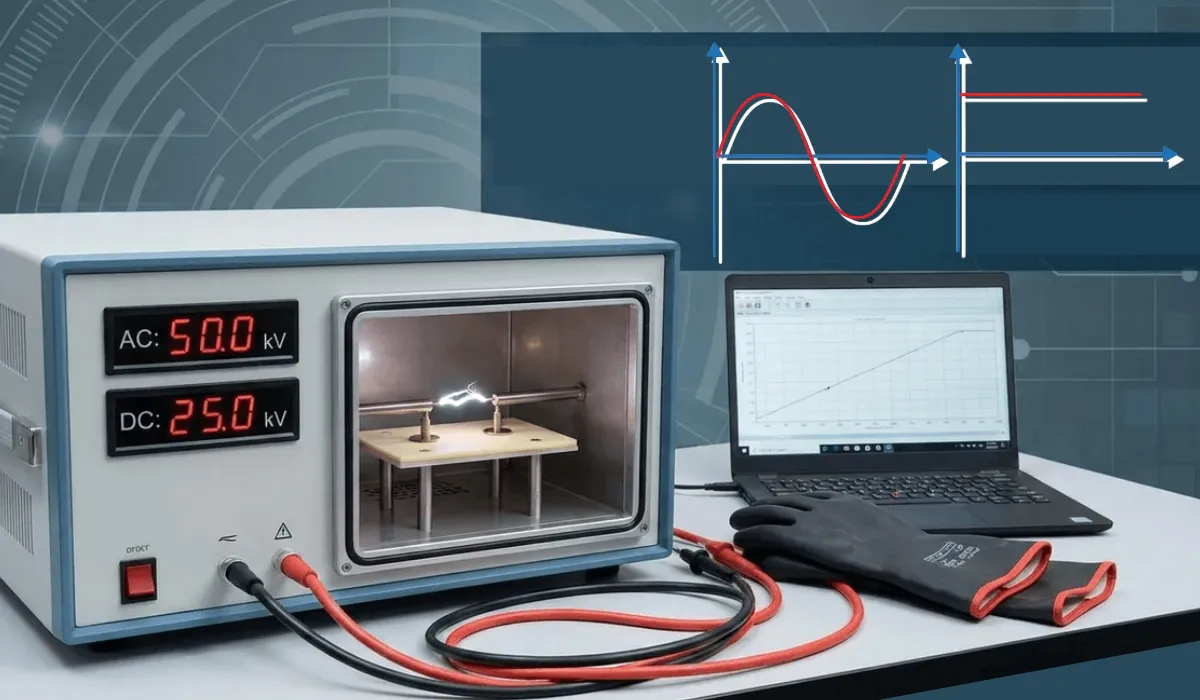
A High Voltage Breakdown Tester is a specialized electrical test instrument used to apply high voltages (either AC and DC) to components, systems, or insulating materials to verify their ability to withstand operating voltages without breakdown or excessive leakage. The tester gradually increases voltage until a predetermined threshold is reached, monitoring leakage currents and detecting insulation failures.
Depending on the application, these testers can generate voltages from a few kilovolts (kV) to hundreds of kilovolts — making them indispensable for verifying insulation safety in electrical products like motors, transformers, cables, capacitors, and consumer electronics.
Testers are offered in AC only, DC only, AC/DC combination models, and with features like programmable test sequences, digital displays, automatic cutoff on failure, and adjustable current trip settings.
AC vs. DC High Voltage Testing: What’s the Difference?
AC High Voltage Testing
AC (Alternating Current) testing applies an alternating voltage at a specified frequency (usually 50/60 Hz) between electrical points (e.g., conductor to ground). AC testing checks how the insulation handles repeated electrical stress and simulates real operating conditions for AC systems.
Key Uses
- Testing insulation for motors, cables, and transformers
- Detecting partial discharge and tracking weakness in insulation
- Verifying compliance with IEC/ANSI standards

DC High Voltage Testing
DC (Direct Current) testing involves applying a steady voltage to insulation. DC tests are good for identifying latent defects, poor joints, or contamination that might not show up under AC stress.
Difference Summary
- AC tests stress insulation with alternating polarity cycles.
- DC tests apply steady stress and make it easier to control leakage current interpretation.
Both AC and DC tests are valuable — and modern high voltage testers allow switching between modes as needed.
Working Principle of a High Voltage Breakdown Tester
The basic principle of a breakdown tester is:
- Voltage Ramp-Up: The tester gradually increases high voltage from zero to the set test voltage across the device under test (DUT).
- Leakage Monitoring: During voltage application, the tester monitors leakage current. Excessive leakage indicates insulation degradation.
- Breakdown Detection: If the insulation fails (i.e., dielectric breakdown occurs), the tester detects a sudden spike in current and immediately cuts off high voltage.
- Pass/Fail Result: The tester indicates test status — Pass if the DUT withstood the applied voltage without breakdown; Fail if it could not.
What Does HV Test Mean?
HV Test stands for High Voltage Test, a procedure where high voltage is applied to ensure insulation integrity and safety. In electrical engineering, HV tests are part of dielectric withstand testing and high potential (Hipot) tests designed to simulate extreme stress and validate whether insulation will hold under normal or fault conditions.
In simple terms:
HV Test = Applying controlled high voltage to confirm insulation will not fail beyond a specified threshold of High voltage applied.
It’s not a measurement of everyday operating voltage — it’s a safety and compliance test.
Purpose of High Voltage Testing
The high voltage test exists for safety, compliance, and reliability. Its core purposes include:
1. Ensuring Insulation Integrity
By applying voltages above normal operating levels, manufacturers can catch flaws that might cause arcing, short circuits, or premature failure.
2. Regulatory Compliance
Many standards (IEC 60840, IEEE, UL, IS 10810 Part 45 , etc.) mandate high voltage testing as part of quality assurance and certification protocols.
3. Preventing Field Failures
Products that pass high voltage tests have a lower risk of failing under load, protecting end-users and reputations.
4. Quality Assurance
Routine HV testing during production ensures consistent insulation performance across batches.
In essence, HV testing guarantees that electrical insulation will remain robust, safe, and durable throughout the product’s lifecycle.
Why Are Probes Used in High Voltage Testing?
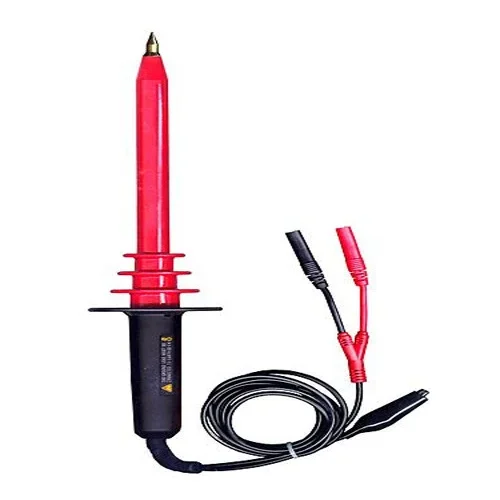
Probes are essential accessories in high voltage testing for the following reasons:
1. Accurate Voltage Application
High voltage probes help in transferring the test voltage from the tester to the point of measurement or test point without distortions.
2. Safe Measurement
Probes are designed with appropriate insulation and attenuation to safely measure or apply high voltages beyond the range of ordinary measuring tools.
3. Isolation
Probes isolate the measurement instrument (like a meter or tester) from hazardous potentials, thereby preventing damage and ensuring operator safety.
4. Measurement Precision
High voltage probes often include voltage division networks that make it possible to accurately scale down high potentials for measurement.
In short, probes ensure both precision and safety during high voltage tests, preventing equipment damage and operator risk.
How to Calibrate a High Voltage Tester Using a Probe
Calibration ensures that the tester and associated probes measure voltage and current precisely.
Here’s a simplified approach to calibration using a high voltage probe:
- Use a Certified Reference Source: Connect the probe and tester to a known calibrated high voltage source.
- Set Desired Voltage: Apply a reference high voltage (e.g., a calibrated 5 kV AC or DC) to the system.
- Record the Tester Reading: Compare the tester’s reading with the reference.
- Adjust Calibration Parameters: If readings deviate beyond acceptable limits, adjust the tester’s calibration settings or use compensation factors.
- Repeat at Multiple Points: Perform calibration at low, mid, and high ranges to ensure linear performance.
- Document Results: Record before/after results to meet compliance and calibration traceability requirements.
Proper calibration (preferably by a trained technician) ensures consistent, reliable test results and enhances trust in your high voltage testing process.
High Voltage Tester Price (India & Global)
Prices of high voltage testers vary significantly based on voltage range, features, automation, and application. Approximate price ranges in India are:
| HV Tester Type | Typical Price (INR) |
|---|---|
| 5 kV Tester | ₹15,000–₹25,000 (basic) |
| 10–30 kV AC/DC | ₹30,000–₹80,000 |
| 70–100 kV Industrial | ₹1,20,000–₹2,50,000+ |
| Advanced Automatic Hipot | Higher, depending on custom features |
These reflect market expectations — for example, entry-level 5 kV breakdown testers are found around ₹15,000–₹28,000, while industrial AC/DC testers up to 70 kV may cost over ₹1,25,000
For global brands with advanced interfaces or lab-grade precision, prices (in USD) can range from $1,500 to $7,000+ — depending on AC/DC functions, leakage detection, channels, and safety features
Manufacturers of High Voltage Testers (HIPOT)
Several reputable manufacturers and suppliers specialize in high voltage testing equipment. Key names include:
Manufacturers in India and abroad
- Maxwell Scientific Corporation – Based in Ambala Cantt, India; known for quality high voltage testing solutions
- Wuhan GDZX Power Equipment – Based in China. There is issue of after sales service due to overseas technical support
- Scientific Mes-Technik – Based in Mumbai. Manufacturers of High Voltage test equipment
- Fluke – Established global supplier of High end test equipments
- Wuhan Goldhome Hipot Electrical – AC/DC Hipot/IR testers available but based out of China
- GW-INSTEK – Known for electrical safety test equipment
- Megger – HV insulation and hipot testers
- ITECH / KEYSIGHT / THETA – Test & measurement leaders
Key Features to Look For in a High Voltage Tester

When selecting a tester, consider:
1. Voltage Range
Choose a device with sufficient range to cover the insulation levels you need to test. For example 5kV, 10kV, 100kV etc.
2. Leakage Current Setting
Adjustable current trip thresholds ensure testing aligns with your standards. For example 10mA, 50mA or it could also be in Amperes for big HIPOTs.
3. Safety Features
Interlocks, overcurrent protection, earth fail indicators, and zero-start switches help protect operators and equipment.
4. Display & Controls
Modern testers include digital displays, programmable sequences, and interfaces that enhance usability.
5. Compliance & Certifications
Ensure testers meet applicable standards (IS/IEC/IEEE/UL) for safety and performance.
Safety Precautions for High Voltage Equipment
High voltage testing can be dangerous if not performed correctly. Here are essential safety precautions:
1. Qualified Operators Only
Ensure only trained personnel handle HV equipment. And there should always be more than 1 operator in the laboratory when the test is being performed.
2. Proper PPE
Wear insulated gloves, eye protection, and flame-resistant clothing where necessary.
3. Clear Work Area
Restrict access to test areas with barriers and warning signs.
4. Grounding
Make sure the test setup and DUT are properly grounded.
5. Interlocks & Emergency Stops
Use safety interlocks and easy emergency shutdown options.
6. Discharge After Test
Always discharge stored energy in the DUT before touching it.
7. Follow Standards
Refer to relevant standards for safe test procedures.
These measures help prevent electric shock, fire, or equipment damage.
Applications of High Voltage Breakdown Testers
These testers are widely used in:
- Electrical appliance testing
- Cable and wire insulation verification
- Transformer and motor manufacturing
- High voltage component R&D
- Switchgear and panel testing
- Quality assurance labs
By detecting insulation faults early, they save costs and protect lives.
Frequently Asked Questions (FAQs)
1. What is the difference between breakdown voltage and flashover voltage?
Breakdown voltage refers to insulation failure within the material, while flashover occurs across the surface of insulation due to contamination, humidity, or insufficient creepage distance.
2. Why is ramp rate important in a high voltage breakdown test?
A controlled ramp rate prevents sudden overstressing of insulation and ensures repeatable, standard-compliant breakdown measurements.
3. How does humidity affect high voltage breakdown testing?
High humidity reduces surface resistance, increases leakage current, and can cause premature flashover, leading to false failures.
4. Why is DC breakdown voltage usually higher than AC breakdown voltage?
DC voltage does not produce continuous polarity reversal, reducing dielectric heating and resulting in higher apparent breakdown values.
5. Can a Hipot test detect insulation aging?
Yes, gradual increases in leakage current over repeated tests indicate insulation degradation or aging.
6. What is the role of leakage current monitoring in HV testers?
Leakage current monitoring helps identify weak insulation paths before complete breakdown occurs.
7. How does electrode shape affect breakdown voltage results?
Sharp electrodes concentrate electric fields, lowering breakdown voltage, while rounded electrodes provide more uniform field distribution.
8. What is the difference between type test and routine HV test?
Type tests validate product design, while routine tests ensure production units meet safety requirements.
9. Why is a soak time required before applying high voltage?
Soak time allows capacitive charging and stabilizes leakage current before the actual test begins.
10. What happens if a device fails a Hipot test but passes insulation resistance test?
Hipot tests apply higher stress and can reveal weaknesses not visible at low-voltage insulation resistance measurements.
11. Why is DC Hipot preferred for long cable testing instead of AC?
DC testing avoids high charging currents seen in AC tests and simplifies leakage current measurement for long cables.
12. How is breakdown location identified after a failure?
Breakdown location can be found using visual inspection, partial discharge analysis, or thermal imaging.
13. What is the impact of test duration on breakdown results?
Longer test durations increase dielectric stress and can reduce the observed breakdown voltage.
14. Can repeated high voltage testing weaken insulation?
Yes, excessive or repeated HV tests can cause cumulative insulation stress and micro-damage.
15. Why are oil-immersed tests used for high voltage components?
Oil provides uniform dielectric strength and prevents surface flashover during very high voltage testing.
16. Why is partial discharge testing sometimes combined with Hipot testing?
Partial discharge testing detects early insulation defects before complete breakdown occurs.
17. How does frequency affect AC breakdown voltage?
Higher frequencies increase dielectric losses, reducing breakdown voltage due to increased heating.
18. What is the role of current limiting in HV breakdown testers?
Current limiting protects both the tester and the device under test during breakdown events.
19. Why are shielded test enclosures used in HV labs?
Shielded enclosures reduce electromagnetic interference, improve safety, and prevent accidental contact.
20. What is the difference between destructive and non-destructive HV testing?
Breakdown tests are destructive, while withstand (Hipot) tests are non-destructive when done correctly.
21. How does insulation thickness influence breakdown voltage?
Thicker insulation generally increases breakdown voltage, but material quality and uniformity also matter.
22. Why is temperature monitoring important during HV testing?
Rising temperature indicates dielectric heating and potential insulation failure.
23. What calibration uncertainty is acceptable for high voltage testers?
Typically ±1% to ±3%, depending on standards and voltage range.
24. Can HV breakdown testing be automated?
Yes, modern testers offer programmable voltage ramps, dwell times, pass/fail limits, and data logging.
25. What causes false failure in high voltage testing?
Contamination, humidity, poor grounding, damaged probes, or incorrect test setup.
26. When should breakdown testing be avoided?
Breakdown testing should be avoided on finished or customer-ready products as it permanently damages insulation.
27. What is the difference between AC and DC high voltage testing?
AC testing simulates real operating conditions, while DC testing is often used for capacitive loads and provides stable leakage current measurement.
28. What is dielectric strength?
Dielectric strength is the maximum electric field or voltage an insulating material can withstand without electrical breakdown.
29. Why are probes used in high voltage testing?
Probes are used to safely measure high voltages, provide isolation, reduce voltage levels for instruments, and improve measurement accuracy.
30. What types of probes are used in HV testing?
High voltage divider probes, resistive probes, and capacitive probes are commonly used depending on voltage range and application.
31. How do you calibrate a high voltage tester using a probe?
Calibration is done by applying a known voltage, measuring it through a calibrated high voltage probe, comparing readings, and adjusting the tester output if required.
32. How often should a high voltage tester be calibrated?
Typically, calibration should be done once a year or as recommended by standards and quality systems like ISO 9001 or NABL.
33. What safety precautions should be taken during HV testing?
Use trained personnel, proper grounding, safety interlocks, insulated PPE, warning signs, and always discharge the device after testing.
34. Is high voltage testing dangerous?
Yes, if not handled properly. High voltage can cause severe injury or death, which is why strict safety procedures are mandatory.
35. What happens when insulation breaks down?
Electrical arcing occurs, causing excessive current flow, heat, damage to equipment, and potential safety hazards.
36. What leakage current is acceptable during a Hipot test?
Acceptable leakage current depends on standards and product type but is usually in microampere or milliampere ranges.
37. What products require high voltage testing?
Cables, wires, transformers, motors, switchgear, panels, electronic equipment, and insulation materials require HV testing.
38. Can high voltage testing damage the product?
If test voltage or duration exceeds specified limits, it can stress or damage insulation. Proper test parameters prevent damage.
39. What standards specify high voltage testing?
Standards include IEC, IS (Indian Standards), UL, IEEE, ASTM, and ISO depending on product category.
40. What is the typical test voltage for a Hipot test?
Test voltage is usually 2 to 3 times the rated operating voltage, as defined by applicable standards.
41. What is the price of a high voltage breakdown tester in India?
Prices range from approximately ₹15,000 to ₹1,50,000 or more, depending on voltage rating, features, and automation.
42. Who are the leading manufacturers of Hipot testers?
Popular manufacturers include Maxwell Scientific Corporation, Denko, Ujwal Electronics, Excel Technologies, SB Electro Tech, GW-INSTEK, Megger, and Hipotronics.
43. Can high voltage testers be used in production lines?
Yes, automated and programmable Hipot testers are widely used for inline production testing.
44. Why is grounding important in high voltage testing?
Proper grounding ensures safety, prevents electric shock, and protects equipment from accidental discharge.
45. Can one tester perform both AC and DC tests?
Yes, many modern high voltage breakdown testers support both AC and DC testing modes.
Conclusion
Investing in a High Voltage Breakdown Tester (AC/DC) is essential for any facility that deals with high voltage insulation verification and compliance testing. Whether you’re a manufacturer aiming to meet standards or a technician ensuring product safety, understanding these testers — their features, proper use, calibration methods, safety protocols, and market options — will elevate the quality of your testing outcomes.
At Maxwell India, we bring expertise and products that help you achieve reliable, accurate, and safe high voltage testing. Explore our range of solutions and contact us for tailored support.